
Webster Students Tour Women’s Prison and Its Nursery
November 25, 2026
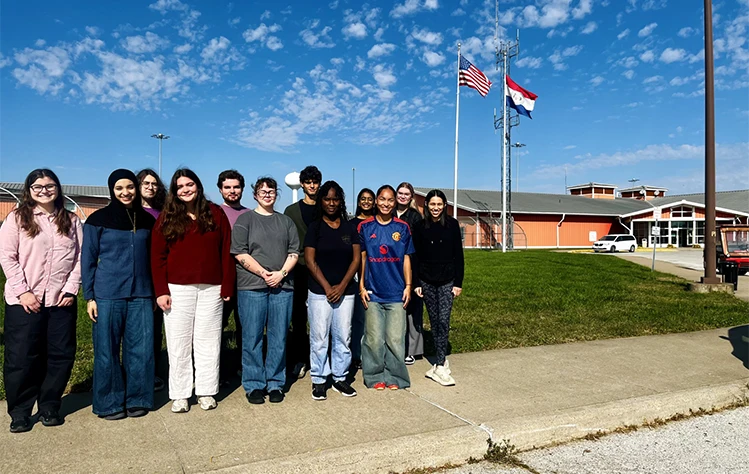
Students in the Corrections and Prisons course visited the Women’s Eastern Reception, Diagnostic and Correctional Center in Vandalia, Missouri, on Oct. 29. Taught by Allison Gorga, PhD, the course explores prison history, programming and the experiences of incarcerated people.
Before the visit, students organized a donation drive, collecting clothing and hygiene products for women preparing for release, as well as baby clothes, diapers and books for the prison nursery.
Established in 2025, the nursery allows mothers who give birth while incarcerated to remain with their babies for up to 18 months. During the tour, Webster students visited the unit and spoke with mothers and caregivers about their experiences. One mother explained how the program lessened the burden on her child’s grandparents. Many of the participants would have placed their children with extended family members, friends or foster care if not for the program.
Sadie Saltsman-Buck, a Criminology major, observed, “The entire layout felt more like a daycare rather than a prison … one of the coolest things was that at this prison, they report their babies meeting milestones earlier than the average.”
Several students connected the visit to course material. Jineen Hamdallah, a Criminology major, reflected, “In our class, we learned about how women incarcerated in the 1900s were made to learn how to cook, clean, sew, and how to be a good overall housewife. I saw that being implemented in the prison nursery and the incarcerated women working as caregivers. These women care for the babies in the nursery … and they are doing similar ‘housewife’ activities … such as learning how to sew blankets.”
Students also visited the service dog training program run by Canine Helpers Allow More Possibilities (CHAMP). Wren Burke, an Anthropology and Sociology major, noted that “apparently many former inmates are offered positions in the organization after their release, which, unlike simply punishing them, will prepare inmates to return to life outside of prison.”
Some students were critical of the tour and what was shown or not shown. Avie Smith, a Film, Television and Video Production major, said, “I had mixed feelings about the experience. While I did see a lot of great programs, some rules and comments didn’t sit right with me.” Smith pointed to the prison’s low-quality bedding and mattresses and to the fact that better bedding was offered to only some women as a reward.
Ben Watkins, a Criminology major, cautioned that the tour focused on “inmates in the special wings of the prison. We did not go into the general areas of the prison, where it is likely that the views and attitudes surrounding punishment vs. rehabilitation would be different.”
Ultimately, students valued the opportunity to connect classroom learning with firsthand experience. Federico Grifasi, a Criminology major, reflected, “I learned that prison is not always like how movies describe it.”
Jasmine Hubbard, a Business Administration major, said, “I feared before our field trip that they may feel like ‘zoo animals’ … I was relieved to hear that they enjoy tours, it makes them feel normal, and more human, being able to interact and talk with us.”