

About the Community Music School (CMS)
Transcript
[Subtle electronic music plays]
[Footage of Webster University Campus including the exterior of CMS Center]
Text on Screen: Community Music School of Webster University
Narrator Since 1925, the Community Music School of Webster University has been a beacon of musical education in the St. Louis region.
[Footage of students playing in an orchestra and a jazz band]
Narrator: Formerly known as the Conservatory and School for the Arts or CASA, and the St. Louis Symphony Community Music School, today, it stands as a proud department of the Leigh Gerdine College of Fine Arts at Webster University.
[Black and white still photos of students playing instruments then fade to inside of CMS Concert Hall]
Text on Screen: Leigh Gerdine College of Fine Arts of Webster University
Narrator: With over 90 dedicated faculty members and more than 1,200 students, the Community Music School offers a diverse range of programs tailored to students of all ages and abilities. At the heart of the school are individual lessons on a variety of instruments, including all band and orchestra instruments piano, guitar, and voice.
[Footage of teachers giving music lessons to music students in multiple locations ending in blurred photo of hands holding a piccolo]
Text Centered on Screen: Individual lessons Band and Orchestra Piano Guitar Voice
Narrator: Unique to the Community Music School is a traditional Suzuki Strings program offering lessons to beginning students starting at age 4, along with their parents.
[Footage of instructors with very young children and their parents and group classes of very young children]
Narrator: The school also offers early childhood classes through Kindermusik International and group piano classes, fostering a love of music from a young age.
[Footage of parents with toddlers and pre-schoolers in group classes]
Narrator: For school-aged students seeking a collaborative experience, there are ensemble programs in chamber music, jazz , strings and a sequential Young People’s Orchestra Program, which includes two full orchestras. Summer camps keep the music momentum going all year long.
[Footage of school-aged children receiving awards, playing in small groups and large orchestras]
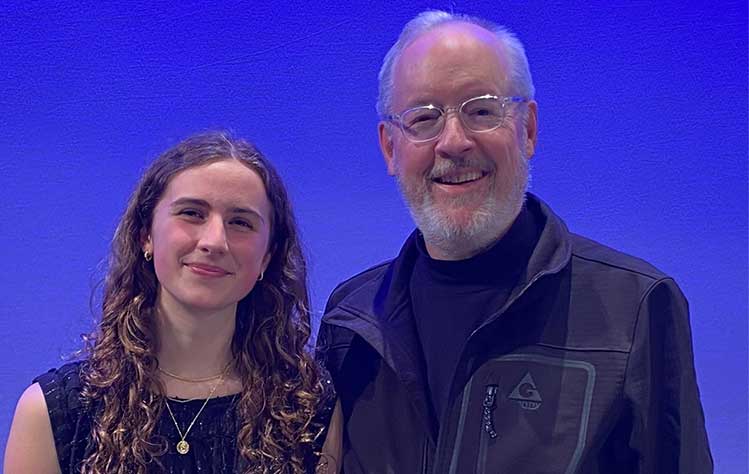
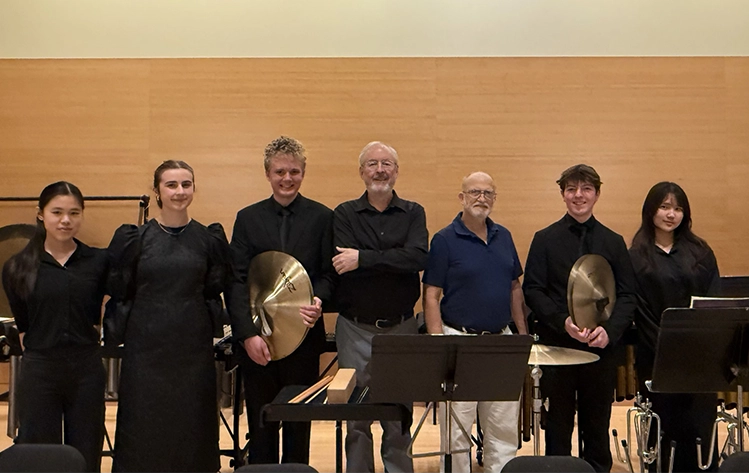
Narrator: There’s even a nationally recognized Young Composers Competition, which brings guest composers from across the nation and features professional musicians playing award-winning works.
[Group photos of winners and guest artists, and adult musicians playing in small ensemble on stage]
Narrator: With two convenient locations in Webster Groves and Chesterfield, the Community Music School is accessible to all in the St. Louis area.
[Arial footage of CMS Center on Webster University Campus and the Leon R. Strauss Center in Faust Park, Chesterfield]
Narrator: And with 85% of our faculty holding advanced degrees, students can trust they are receiving top-notch instruction.
[Footage of interiors at Strauss Center of instructors and students playing instruments in a lesson]
Narrator: Join us at the Community School of Webster University, where music education has been a tradition for a century.
[Footage of young children in a pre-school class and in group piano class fade to white]
Text on screen: Community Music School of Webster University, webster.edu/cms
[screen fade to black]
Quality
CMS instructors and conductors are professional musicians who are also master educators. They are evaluated on a regular basis, and more than 85% have advanced degrees. Faculty Biographies
Locations
CMS has convenient locations in Webster Groves and Chesterfield. Our headquarters on the Webster University campus includes 15 teaching studios, two rehearsal halls and a 470-seat concert hall. More on Locations
Financial Assistance
Need-based tuition assistance, as well as endangered instrument awards, family and multiple instrument discounts, orchestra student discount, and artistic merit scholarships are available. More on Assistance
Performance Opportunities
Monthly recitals give individual lesson students the chance to polish and perform music for others — building goal-setting skills and performance poise. In addition, CMS offers multiple orchestras, ensembles and chamber music for school-aged musicians.
| Event | Date | Time |
|---|---|---|
| Prep Program Concert | Dec. 6 | 7 p.m |
| CMS Jazz Collective | Dec. 11 | 7 p.m |
| String Ensemble/String Orchestra Concert | Jan. 10 | 2 p.m. |
| YPCO Concert | Jan. 24 | 2 p.m. |
| YPSO Concert | Jan. 24 | 6 p.m. |
| Young Composers Competition Concert | March 20 | 4 p.m. |
| CMS and Webster Department of Music Faculty Showcase | April 16 | 7 p.m |
| CMS Jazz Collective | April 23 | 7 p.m |
| String Ensemble/String Orchestra Concert | April 25 | 2 p.m. |
| YPCO Concert | April 25 | 6 p.m. |
| Prep Program Concert | April 30 | 6 p.m. |
| YPSO Concert | May 5 | 6 p.m. |
Masterclasses and Coachings
Through Webster University, the St. Louis Symphony, the St. Louis Classical Guitar Society, Chamber Project Saint Louis and other local partners, CMS students periodically have the opportunity to participate in or observe masterclasses or coaching sessions with nationally and internationally renowned artists, such as Pinchas Zuckerman, violin; Ron Leonard, cello; Gabrielle Cassone, trumpet; Keith Aleo, percussion; Emanuel Ax, piano; and many more.
Affiliations
CMS students benefit through our partnerships with the Webster University Department of Music, the St. Louis Symphony, The Sheldon Concert Hall, St. Louis Public School District, and other arts and community organizations. The CMS is accredited by the National Association of Schools of Music and benefits from membership in the National Guild for Community Arts Education. About CMS
Take a Virtual Tour
By selecting "Virtual Tour," you acknowledge that you are leaving Webster University's website and accessing a third-party website that is independent of Webster University. Webster University does not own, control, endorse or assume responsibility for the content, products, services, security, accessibility or privacy practices of the third-party site. Any collection, use, disclosure, storage or processing of personal information by the third-party site is governed solely by that site's privacy policy and terms of use. Webster University disclaims any liability arising from your use of, or reliance upon, the third-party website or its content. Webster University's Privacy Policy applies only to information collected through Webster University websites and services. To learn more about Webster University's privacy practices, please review please review Webster University's Privacy Policy.
Community Music School Events
Highlights from the Community Music School
CMS Featured on HEC-TV's "Spotlight"
The Community Music School of Webster University was featured on HEC-TV's program "Spotlight" which celebrates all things St. Louis through videos that highlight the arts, economy, culture, history and achievements of the entire metropolitan region on both sides of the Mississippi River.
Transcript
Narrator: Just over a century ago, a flyer appeared in the window of Franklin School on North 19th Street that read, “Anybody interested in music? Join us on Saturday at 1.”
[Slideshow of archival photo of downtown St. Louis and historic brick school building.]
Narrator: It had been placed there by Edna Lieber, a piano instructor who had been advocating for a music curriculum in the St. Louis public schools.
[Black-and-white portrait of Edna Lieber]
Narrator: Raised in a musical family, Edna understood the important role music had played in her own life and was passionate about extending that experience to all. The St. Louis Public Schools Board of Education turned that proposal down.
[Stock footage of sheet music]
Narrator: So Edna went rogue.
[Black-and-white portrait of Edna Lieber]
Narrator: Over 100 children responded to her flyer by showing up to a piano singalong at Edna’s private music studio. This overwhelming reaction to her simple offer was all the encouragement Edna needed.
[Stock footage of a hand playing piano]
Narrator: In 1925 she founded the Community Music School, and thanks to a collaboration with musicians from the St. Louis Symphony, it was able to offer instruction in a variety of instruments.
[Black and white stock footage of violin being played]
Narrator: But Edna wanted to do more than simply make music instruction available within her community. She wanted to make it accessible.
Inspired by the settlement movement, she believed that one step toward overcoming social and financial inequity was to give everyone the opportunity to study and enjoy the arts.
Faculty at the community music school often donated their time or significantly reduced their rates to accommodate anyone who was committed to pursuing music.
[Slideshow of archival image of city street with streetcar, followed by archival photos of groups of young children]
Narrator: Over the years, the Community Music School or CMS has changed and added locations and formed new partnerships, but its mission remains the same.
[Modern footage of CMS buildings]
Text on Screen: Nicole Springer Director, The Community Music School of Webster University
Springer: We make music education accessible for all.
We actually award over $100,000 every year in financial aid and scholarships. So 35% of our students are awarded some sort of financial aid. We never turn a student away if they want to study music.
[Springer seated in her office]
Springer We are primarily pre-K through 12, but we have adult students come and learn a new instrument. We want to get the joy of music-making out to everybody.
[Footage of current students playing cello, slideshow of archival photos of adult students with instructors]
Narrator: DC area native Nicole Springer is also a violinist performing with the St. Louis Philarmonic, Webster University Orchestra and the American Festival Pops Orchestra.
[Footage of Springer walking in CMS lobby followed by slideshow of Springer with violin and orchestra photo]
Springer: I owe my career and where I am sitting right here to music and the music educators in my life who have impacted me. I know the power of music.
[Springer in her office]
Springer: When people come to CMS they come here for the reputation of our school and our faculty.
[Slideshow of black and white photos of students with teachers]
Text on Screen: Jeanine York-Garesche Former CMS Instructor
Jeanine York-Garesche: I could talk about my former students all day. They're all so wonderful and doing great things.
[Jeanine York-Garesche sitting in Concert Hall]
Narrator: In 1974 the Conservatory and School for the Arts or CASA was formed when CMS merged with the St. Louis Institute of Music.
[Historic photographs from the 1970s showing group classes]
Narrator: After finishing her undergrad at the University of Nebraska, clarinetist Jeanine York-Garesche was recruited to come study at CASA and stayed to teach. Now retired from CMS, she still treasures any opportunity to watch her former students perform or even to play alongside them.
[Slideshow of York-Garesche with clarinet student and at retirement party]
York-Garesche: I played an opera this summer for Opera Theater. Working with my students and seeing them accomplish so many different things, it's always a thrill whether I'm on the stage with them or in the audience.
[Footage of York-Garesche playing clarinet with faculty member Katie Myler]
Narrator: One of Jeanine's students, Katie Myler, also ended up becoming a clarinet instructor at CMS and in turn taught Jessica Ingraham, who is now senior director of education for the St. Louis Symphony.
[Footage of Clarinet Master Class video with York-Garesche and Myler]
Text on Screen: Jessica Ingraham Senior Director of Education, St. Louis Symphony
Jessica Ingraham: Katie always tells me that the first time she ever met me, I walked in and told her that I was going to be a band director. I mean, I was like 13 years old at this time and I knew I was going to be a band director.
So Katie set me off on that path and I became a band director. Go figure. My love for music, for working with children, the whole music education side, I think that blossomed here.
[Ingraham sitting in Concert Hall]
Kara Vaninger: Okay. A double bass is a giant instrument. Correct?
[Photo of New York City skyline followed by footage of Vaninger in online video interview]
Text to Screen: Ruth Christopher CMS Alum, Juilliard Student
Ruth Christopher: Yeah.
Vaninger: Do you keep it in your dorm room?
Christopher: I keep it in my apartment. Yeah. I live only a few minutes from school, which was by design. When I moved off campus, I moved somewhere in walking distance so I didn't have to carry it up and down the stairs of the subway all the time.
[Footage of Christopher in dorm room]
Narrator: Ruth Christopher spent most of her young life attending classes at CMS, starting first on the violin before moving to the double bass, which she now shares a Manhattan apartment with while attending Juilliard.
[Group photo with Ruth Christopher holding double bass. Footage of New York City]
Christopher: Entering my undergrad, I was at such an advantage already from having all the experiences I did at CMS and for so many years. It was just really baked into how I functioned as a musician, communication skills, musical skills, personal skills like commitment, determination.
The first week of school, they put us in orchestra orientation, and it felt totally normal. I was confident. I was sure of myself. I knew what I was doing. I was able to prepare my parts efficiently.
I'm fortunate, so lucky, to be getting to perform and rehearse regularly with the Met Opera. So I've been doing that this season. The stuff I learned at CMS is what I use every day in the pit.
[Footage of Christopher in dorm room and slideshow of photos of Christopher playing or posing with double bass]
Garesche: The people that tend to come to CMS tend to be the cream of the crop. They tend to be the best players, the most dedicated, the most, ‘I want to pursue this and I love this.’ I feel like we get those people that come in at a young age and then they just blossom.
[Footage of Garesche interview in concert hall]
Narrator: Timothy, Elizabeth and Rachel Lamb are all part of the Suzuki strings program at CMS, which provides a unique alternative to traditional instruction.
[Footage of Timothy, Elizabeth and Rachel Lamb on in quad on campus]
Text on Screen: Samuel Lam CMS Parent
Samuel Lam: The Suzuki program actually requires the parents to be there and take notes. Originally when it was developed the teacher actually spent quite a bit of time teaching the parents what they are teaching the kids so that the parents can help guide them when they practice.
[Lam sitting in concert hall]
Narrator: But in the Lam household where both parents have musical backgrounds that was bound to happen anyway.
[Footage of Lam family walking on sidewalk on campus]
Vaninger: I hear somebody else in your family also plays the violin. Who else does that?
Lam Children: Our dad. Dad.
[Lam children sitting on stools on stage of concert hall]
Narrator: Samuel's years of practicing the violin are now helping him to engage with his children's musical journeys and the consistent opportunities to rehearse and perform at CMS serve as a confidence booster and a community builder.
[Footage of Lam tuning violins for each child]
Samuel Lam: They have group concerts, they have recitals, they have other student recitals, they have group recitals with the whole community. I think not only do they learn the skill, they really enjoy and have fun doing it. They are not shy to perform.
[Footage of Timothy playing violin in quad by Thompson House followed by footage of students playing violin in orchestra and still photo of group of students playing at Powell Concert Hall]
Text on Screen: Holly Lam CMS Parent
Holly Lam: When they first started learning the violin, they didn’t start with the songs. They started with the pose and how to pick up a violin and get the right pose. And even for that, they had the kid go onto the stage and perform for the parents.
[Footage of Samuel and Holly Lam on stools in the concert hall also archival footage of students all holding bows in upright position]
Springer: And that's really what music does. Music instills confidence in students. If you learn discipline, teamwork and collaboration, self-expression it is developing a young person's character. It is giving that foundation for whatever they do later on in life.
[Footage of Springer in office interspersed with footage from orchestra concert, pre-school music classes and lessons]
Narrator: CMS offers everything from early childhood and chamber music programs to young composer competitions and summer camps. It has over 1200 students, 90 faculty and two sites, including the Leon Strauss Center for Music in Fast Park. The Community Music School is just one more example of St. Louis's ongoing commitment to the arts.
[Slideshow of photos from existing programs followed by slideshow of archival photos of similar programs]
Christopher: I just feel so lucky to have been able to benefit from CMS. I really feel like I've been folded into this legacy that has helped so many kids like me.
[Footage of video interview in dorm room followed by slide show of current and archival photos of lessons, group classes and performances]
York-Garesche: It's been part of my whole adult life. Giving back through music and working with the young people, seeing them do well, that's CMS's legacy.
[Slideshow of lesson and group class photos followed by footage of CMS orchestra playing]
Contact Us
Phone
314-968-5939
Mailing Address
470 E. Lockwood Ave.
Webster Groves, MO 63119