

Transforming Lives Through Literacy and Service
The Student Literacy Corps (SLC) is a community service program through which Webster students are trained as reading tutors and serve in local schools providing one-on-one support to new and struggling readers of all ages.
Created in 1990, this innovative model for education was designed with the dual purpose of benefiting university students through service-learning experience and low-literacy populations through individualized, consistent tutoring. SLC participation has a transformative impact on both the students it serves and the tutors who assist them.
Making a Difference
 Kathryn Hayden, Teacher, Gateway MST Elementary
BA in Elementary Education, '19
"Tutoring for Webster University's Literacy Corps helped me find my true purpose in life ... I continue to teach students that they can be anything they want to be, if they put their minds to it."
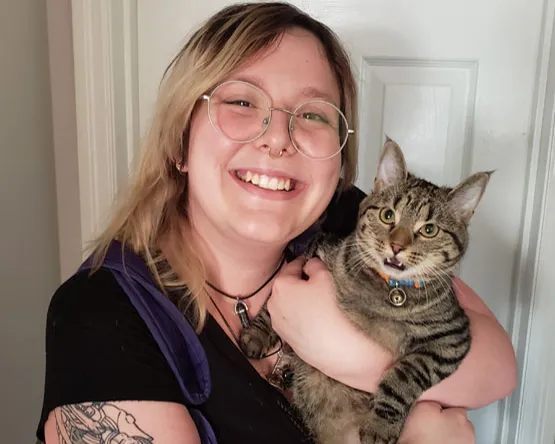 Shelby Morgan
BA in Creative Writing, '22
“I've found that students, regardless of age, respond really well to our materials. It's always an amazing feeling when students, especially those reluctant to read, learn that there are books out there for them.”
Find Out How SLC is Making a Difference
Transcript
[Subtle music plays]
[Footage of photos of the students and staff of the Student Literacy Corps]
Text on screen: Making a Difference in the Lives of Students – Student Literacy Corps
Kate Northcott, Director, Student Literacy Corps: “Webster’s Student Literacy Corps is a community service program through which Webster students are trained and placed as tutors, serving new and struggling readers in schools in our community.
[Footage of young child being tutored, two Webster students who are tutors walk down the steps from Webster Hall, a child reading and some elementary students walking into their school]
Over the last 34 years, it's grown so that we welcome tutors from every school on campus, graduate, undergrad, international students.
[Footage of a student being tutored]
Student Tutor Samantha F. Education: I thought it would be an amazing opportunity to grow my skills in teaching, and it was a way to take the knowledge that I was learning in the classes and apply it in the moment, rather than waiting for that end experience.
[Footage of a little boy holding a book smiling]
Kate Northcott, Director, Student Literacy Corps: Now, more than ever, teachers need our support. Since lockdown, we have found we have more and more students who are four or five years behind reading level, instead of one or two. The support of a tutor providing one-on-one attention helps supplement the teacher’s hard work.
[Footage of young child being read to in the library, a young teenage boy looking at the computer screen, a shot of the screen of an online class with 9 students]
Student Tutor Sage H. Psychology: I was working with a new student. Part of our routine was just reading aloud and the teacher turned to me one day and she goes, you know, before you started working with him, he refused to read aloud, and that really impacted me. He really just needed that individualized attention that Student Literacy Corps
makes possible.
[Footage of a young student looking confident while sitting in a group in the library]
Kate Northcott, Director, Student Literacy Corps Currently, we have about 30 tutors going out to a variety of schools in our community. We serve schools that serve the highest needs learners. That is, students in schools that serve very low-income areas, students who serve high-needs learners, like newly arrived, non-English speaking immigrant and refugee students in our community.
[Image of a school hallway with a graphic that reads: “30 Tutors: Webster literacy tutors serve students with highest needs.” Footage of a tutor helping a young boy, footage of paintings of the wall of the school hallway]
Student Tutor Zoe D. Journalism and Dance: Many of my students, their first language is Spanish, and I studied Spanish for seven years. I would say that I speak it enough that I can help the students when they struggle with the translation. In the end, it usually flourishes into this lovely relationship where the student trusts this tutor to be an advocate for them. And I do believe that as tutors, we are advocates for our students.
[Photo of Zoe in front of a St. Louis Community College sign, photo of a white board with instructions for her tutoring that day, footage of Zoe walking through the Webster University campus]
Kate Northcott, Director, Student Literacy Corps They see them as an individual. They are comparing where they were on day one when the tutor met them to where they are now. They will always be doing better. And the tutor points out to them the progress that they've noticed, and that's a big boost for students who feel far behind in the classroom. With their tutor, they recognize they are moving forward.
[Footage of young students working or listening in the elementary age classrooms]
Student Tutor Briahni A. Education: Every moment that they achieved understanding of a new syllable or a new combination of syllables, they were motivated to learn more and to do more. It was always amazing to see how encouraged they were to continue learning every time they succeeded.
[Footage of a girl reading a book, a boy sitting outside smiling to the camera, a bulletin board with “Never Settle for Less than your Best” written above]
Kate Northcott, Director, Student Literacy Corps That commitment from a caring adult who believes in them as learners, who knows them as individuals, that makes a big difference, and that's a good feeling, because you have somebody that's in your corner and they know their tutor has no agenda beyond their success.
[Footage of a tutor working with children and a student tutor (Brihani) walking on Webster University’s campus]
Student Tutor Muazuddin M. Computer Science: There was this little girl who was very overwhelmed while walking back to class, and I said, “hey, just step aside for a while I'll give you a minute. Do whatever you need to do to cool yourself back down, and then we can go back up to class together.” The joy that she felt that someone was there to understand how she was feeling, and react appropriately, she ran up to me and gave me a hug. And I just felt my heart pop.”
[Footage of a little girl on a swing on the school playground]
Kate Northcott, Director, Student Literacy Corps: We know that the Student Literacy Corps has a profound impact on the students we serve, and we're very proud of that. But what we hear from our alumni tutors is the experience of tutoring had of transformative impact on their lives, and it changed the way they looked at the world.
[Graphic of Webster Journal headlines that say, “Webster student tutors enrich education for local kids” and “Webster tutors help struggling students during pandemic.” Video pans of other deadlines that say, “Hooked on helping: Literacy Corps improves reading, esteem in kids” and “Literacy tutor breaks language barrier with music.”]
Student Tutor Samantha F. Education: I'm so glad that I chose to be a literacy tutor. It has provided me with so many opportunities to see schools that I never thought I would be able to teach in. It has also helped to prepare me and help me to be more confident in my teaching abilities as I'm going into my apprentice teaching.
[Footage of Samantha tutoring and teaching]
Student Tutor Briahni A. Education: The tutoring program has allowed me to feel affirmed as an educator – knowing that I am getting the skills and tools necessary to be valuable and effective in the classroom.
[Footage of Briahni and Sage talking on campus]
Student Tutor Sage H. Psychology: I feel very encouraged by the kids to grow and to be the best version of myself, just as they're doing.
Student Tutor Zoe D. Journalism and Dance: I wish that someone would have sat with me and worked with me one on one to get me where I needed to be. So now, as a tutor, it's an honor and a pleasure for me to sit with the student, see where the struggles are, and work together to get them to where they need to be.
[Footage of Zoe on campus and tutoring a student]
Student Tutor Muazuddin M. Computer Science: After the tutoring experience, I just felt like a completely different person, because unfortunately, not everyone gets to experience education in the same manner. But being able to help someone else have a better educational experience, that was the most meaningful experience that I’d ever had.
[Footage of Muazuddin walking down a hallway on campus and a close up of him thinking and nodding with a smile.]
On screen: Overview of the Webster building with the Webster logo.
How to Get Involved
Student Literacy Corps tutors support new and struggling readers through weekly in-person visits to their school. Tutors work closely with their students' teachers to address specific skills and concepts. Their lessons are often supplemented with books and learning activities chosen to meet individual students' interests and needs.
Federal Work-Study
If you are an undergraduate eligible for Federal Work-Study, you may be able to use that award to work with the Student Literacy Corps. Check in with the SLC coordinator and the Student Employment Coordinator to pursue this opportunity.
Contact
Contact Student Literacy Corps Director Kate Northcott in the School of Education for more information about SLC and how to support it or participate.
Phone: 314-968-7479
Email: northcot@webster.edu
Tutors Learning Through Service
Michael Guthrie

A Marine Corps veteran who double-majored in Secondary Education and History, Michael Guthrie is now a high school Social Studies teacher. He found his calling through SLC. He tutored refugee and immigrant students at Nahed Chapman New American Academy, and described the experience as life-changing.
“I’ve never felt so much pride and satisfaction with any other work. These kids are adjusting to a new culture, just like I did after the military. I connect with that feeling. SLC helped me realize I truly want to teach.”
Guthrie’s dedication earned him the Dean’s Award for Service, and his story reflects the deep personal growth that SLC fosters.
Michael Guthrie and his wife, Anna, who is also a Webster alum, '18
Josh King

“My work with the SLC has been a testament to a cultivated future: a collection of second chances for people who might otherwise be considered ‘lost’ by education.
"I had the honor of working with returning students – many adults – who were studying to obtain their GEDs in a night course in St. Louis. Much of my role was just about clarifying, dispelling or helping ease the anxiety about learning itself. On more than one occasion, a small 'aha' moment was all it took, and they'd be off: flying through the material with confidence and even a wry sense of joy! It was such a beautiful and inspiring thing to witness and help facilitate where I could. As I think back, the students I connected with in SLC helped me identify and understand several core puzzles of pedagogy. Above all, they left a lasting personification of the courage, tenacity and humility it takes to be a lifelong learner."
King graduated in 2008 and is now Vice President of Grants and Compliance at the Metropolitan Organization to Counter Sexual Assault (MOCSA).

“Being a tutor with SLC ... helped me deepen my passion for teaching. Seeing the joy of learning and 'aha' moments shine on my students' faces was the highlight of every tutoring session.”
MA in Teaching English to Speakers of Other Languages, ’21