


ACBSP Standard 4: Continuous Improvement
The Walker School of Business & Technology is committed to educational excellence and transparency. We are proud to have earned specialized accreditation for several of our business and management programs through the Accreditation Council for Business Schools and Programs (ACBSP).
ACBSP’s global mission is to pursue a better tomorrow by advancing and recognizing excellence in business education through a philosophy of continuous improvement. As part of this commitment, we adhere to ACBSP Standard 4, which mandates that the business unit maintains a systematic student learning outcomes assessment process.
Our Assessment Process
To ensure our curriculum remains rigorous and relevant, we have developed and implemented specific Student Learning Outcomes (SLOs) for every accredited program. This systematic plan allows us to:
- Measure Performance: Evaluate student mastery of core competencies using both internal case analyses and external standardized benchmarking, such as the Peregrine Assessment.
- Identify Trends: Monitor multi-year data to determine where students are excelling and where instructional adjustments may be needed.
- Implement Improvements: Use data-driven insights to update course materials, refine teaching strategies, and modernize program infrastructure.
Transparency and Communication
In alignment with ACBSP requirements, we communicate these assessment results to our stakeholders, including students, faculty, alumni and the broader business community.
Undergraduate: Measurement and Analysis of Student Learning and Performance
For all Program Learning Objectives, the following performance measure was used:
- Pairwise Improvement: Results categorization based on total ACBSP school average outbound score of 60:
- High: average scores 70 and above
- Medium: average scores 50-70
- Low: average scores below 50
Program Learning Objective 1 (PLO 1)
Objective: Systemic Thinking: Students understand the big picture of a business: how the business is impacted by outside forces and how it is driven by its interconnected internal functions.
| Performance Measure | Pairwise Improvement |
|---|---|
| Instrument/Process | Peregrine Exam. Inbound scores measure a baseline at the beginning of a student's program, in MNGT 2000 or MNGT 2100. Outbound scores in MNGT 4900. Direct, comparative, formative, summative, external. |
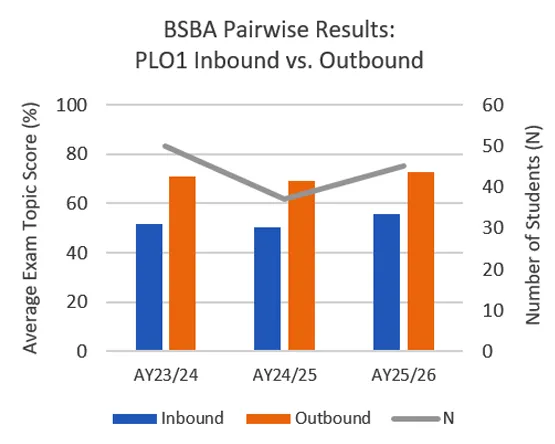
| Current Results | Pairwise results use the inbound and outbound results for the same students. For the most recent academic year, the average inbound score in the relevant areas is 50/100. The average outbound score in the relevant areas is 69/100. This year's results show a 37% increase in students' scores as a result of completing the program. The increase percent is the same as last year. |
| Analysis of Results | Results meet goals. Average outbound results are at the top of the medium category, individual students' scores increased by a large margin during their time in the program, and our outbound scores exceed those of our peer institutions. |
| Action Taken or Improvement Made | 2024-2025 is the first year that the new program learning objectives have been rolled out system wide. We will wait for another year or two of data before making any big changes. One action we have taken is 2025-2026 is the first year we are offering this program online. |
| Insert Graphs or Tables of Resulting Trends |
Image TranscriptBSBA Pairwise Results: Inbound vs. Outbound (Learning Objective 1)Description: Dual-axis chart displaying average Peregrine exam scores for PLO 1 (Systemic Thinking) comparing Inbound (blue bars) and Outbound (orange bars) performance against student sample size (gray line) over three academic years. Data Breakdown
Summary: Outbound results meet program goals and remain at the top of the medium category. In the most recent year (2025-2026), students achieved a 37% score increase from inbound baseline to outbound completion. |
Program Learning Objective 2 (PLO 2)
Objective: Problem Solving: Students can identify business problems and opportunities, analyze them and formulate potential strategies to address them.
| Performance Measure | Pairwise Improvement |
|---|---|
| Instrument/Process | Peregrine Exam. Inbound scores measure a baseline at the beginning of a student's program, in MNGT 2000 or MNGT 2100. Outbound scores in MNGT 4900. Direct, comparative, formative, summative, external. |
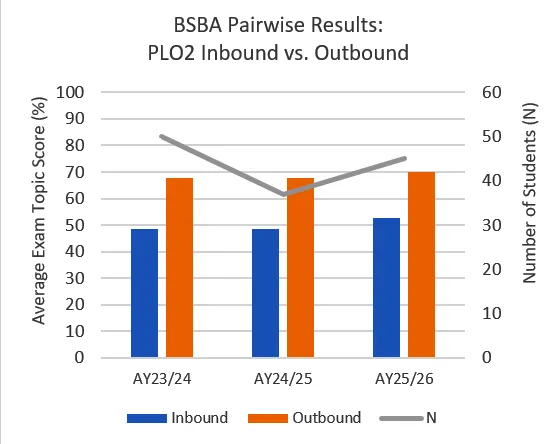
| Current Results | For the most recent academic year, the average inbound score in the relevant areas 49/100. The average outbound score in the relevant areas is 68/100. This year's results show a 39% increase in students' scores as a result of completing the program (last year was 40%). This is from pairwise data. |
| Analysis of Results | Results meet goals. Average outbound results are in the medium category (but just 2 below "high"), individual students' scores increased by a large margin during their time in the program, and our outbound scores exceed those of our peer institutions. |
| Action Taken or Improvement Made | 2024-2025 is the first year that the new program learning objectives have been rolled out system wide. We will wait for another year or two of data before making any big changes. One action we have taken is 2025-2026 is the first year we are offering this program online. |
| Insert Graphs or Tables of Resulting Trends |
Image TranscriptBSBA Pairwise Results: Inbound vs. Outbound (Learning Objective 2)Description: Dual-axis chart displaying average Peregrine exam scores for PLO 2 (Problem Solving) comparing Inbound (blue bars) and Outbound (orange bars) performance against student sample size (gray line) over three academic years. Data Breakdown
Summary: Results meet target goals, reaching the high category (70%) in 2025-2056. Pairwise data demonstrates a 39% score improvement during students' time in the program. |
Program Learning Objective 4 (PLO 4)
Objective: Interpersonal Skills: Students understand and can apply theories relating to group processes, group composition and teamwork.
| Performance Measure | Pairwise Improvement |
|---|---|
| Instrument/Process | Peregrine Exam. Inbound scores measure a baseline at the beginning of a student's program, in MNGT 2000 or MNGT 2100. Outbound scores in MNGT 4900. Direct, comparative, formative, summative, external. |
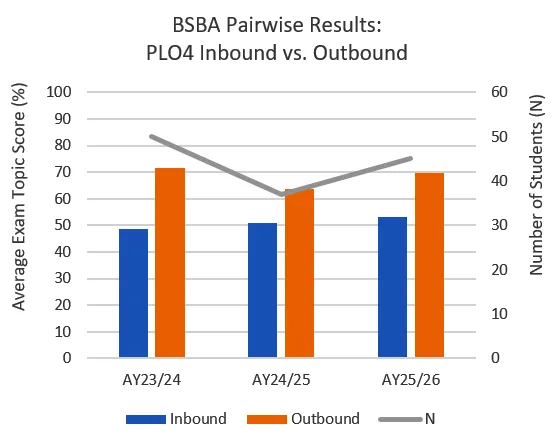
| Current Results | Results meet goals. Average outbound results are in the medium category, individual students' scores increased by a large margin during their time in the program, and our outbound scores exceed those of our peer institutions. |
| Analysis of Results | 2024-2025 is the first year that the new program learning objectives have been rolled out system wide. We will wait for another year or two of data before making any big changes. One action we have taken is 2025-2026 is the first year we are offering this program online. We will watch this one closely, as performance is quite a bit below the prior year's. Changes may be warranted if this trend continues. |
| Action Taken or Improvement Made | See this year's results in the graphs below. Note that last year the Program Learning Outcomes changed, so only a time series of two years is possible. Please see "All LOs" tab for a time series of total exam scores. Please see "Prior Years' Time Series" for the time series graphs of the program's old learning outcomes. |
| Insert Graphs or Tables of Resulting Trends |
Image TranscriptBSBA Pairwise Results: Inbound vs. Outbound (Learning Objective 4)Description: Dual-axis chart displaying average Peregrine exam scores for PLO 4 (Interpersonal Skills) comparing Inbound (blue bars) and Outbound (orange bars) performance against student sample size (gray line) over three academic years. Data Breakdown
Summary: Scores meet program expectations within the medium category (70% in 2025-2026). Performance rebounded in 2025-2026 after a slight dip in 2024-2025. |
Program Learning Objective 5 (PLO 5)
Objective: Technology Literacy: Students can utilize technology to analyze business problems, propose and examine potential solutions and present recommended courses of action.
| Performance Measure | Pairwise Improvement |
|---|---|
| Instrument/Process | Peregrine Exam. Inbound scores measure a baseline at the beginning of a student's program, in MNGT 2000 or MNGT 2100. Outbound scores in MNGT 4900. Direct, comparative, formative, summative, external. |
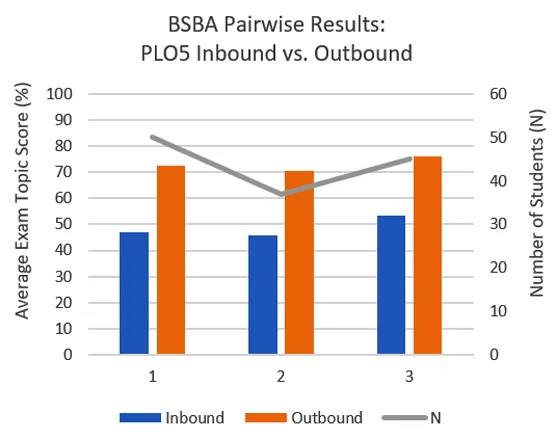
| Current Results | Results meet goals. Average outbound results are in the high category, individual students' scores increased by a large margin during their time in the program, and our outbound scores exceed those of our peer institutions. |
| Analysis of Results | Results meet goals. Average outbound results are in the high category, individual students' scores increased by a large margin during their time in the program, and our outbound scores exceed those of our peer institutions |
| Action Taken or Improvement Made | 2024-2025 is the first year that the new program learning objectives have been rolled out system wide. We will wait for another year or two of data before making any big changes. One action we have taken is 2025-2026 is the first year we are offering this program online. |
| Insert Graphs or Tables of Resulting Trends |
Image TranscriptBSBA Pairwise Results: Inbound vs. Outbound (Learning Objective 5)Description: Dual-axis chart displaying average Peregrine exam scores for PLO 5 (Technology Literacy) comparing Inbound (blue bars) and Outbound (orange bars) performance against student sample size (gray line) over three academic years. Data Breakdown
Summary: Results consistently meet goals, with individual student scores increasing by a large margin. Outbound performance reached the high category at 76% in the most recent evaluation cycle. |
Program Learning Objective 6 (PLO 6)
Objective: Ethical Reasoning: Students can identify and analyze value conflicts and ethical dimensions of business issues and situations.
| Performance Measure | Pairwise Improvement |
|---|---|
| Instrument/Process | Peregrine Exam. Inbound scores measure a baseline at the beginning of a student's program, in MNGT 2000 or MNGT 2100. Outbound scores in MNGT 4900. Direct, comparative, formative, summative, external. |
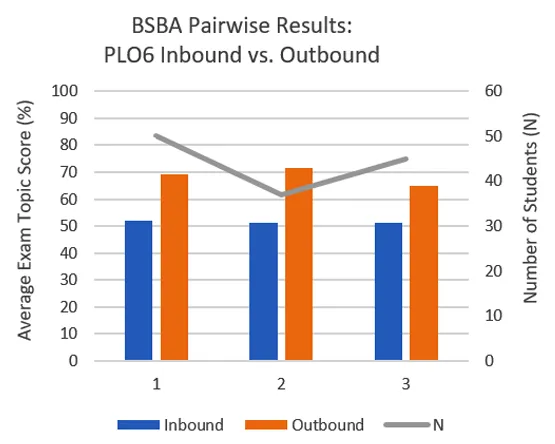
| Current Results | The average inbound score in the relevant areas 51/100. The average outbound score in the relevant areas is 72/100. This year's results show a 39% increase in students' scores as a result of completing the program (last year's increase was 33%). This is from pairwise data. |
| Analysis of Results | Results meet goals. Average outbound results are in the high category, individual students' scores increased by a large margin during their time in the program, and our outbound scores exceed those of our peer institutions. |
| Action Taken or Improvement Made | 2024-2025 is the first year that the new program learning objectives have been rolled out system wide. We will wait for another year or two of data before making any big changes. One action we have taken is 2025-2026 is the first year we are offering this program online. |
| Insert Graphs or Tables of Resulting Trends |
Image TranscriptBSBA Pairwise Results: Inbound vs. Outbound (Learning Objective 6)Description: Dual-axis chart displaying average Peregrine exam scores for PLO 2 (Problem Solving) comparing Inbound (blue bars) and Outbound (orange bars) performance against student sample size (gray line) over three academic years. Data Breakdown
Summary: Outbound scores meet goals and remain within or near the high performance category. Pairwise evaluation for the most recent year reflects a 39% increase in student scores relative to inbound baselines. |
Program Learning Objective 7 (PLO 7)
Objective: Global and Cultural Understanding: Students understand the inherently global nature of modern business and consider international systems and cultural differences in their decision-making process.
| Performance Measure | Pairwise Improvement |
|---|---|
| Instrument/Process | Peregrine Exam. Inbound scores measure a baseline at the beginning of a student's program, in MNGT 2000 or MNGT 2100. Outbound scores in MNGT 4900. Direct, comparative, formative, summative, external. |
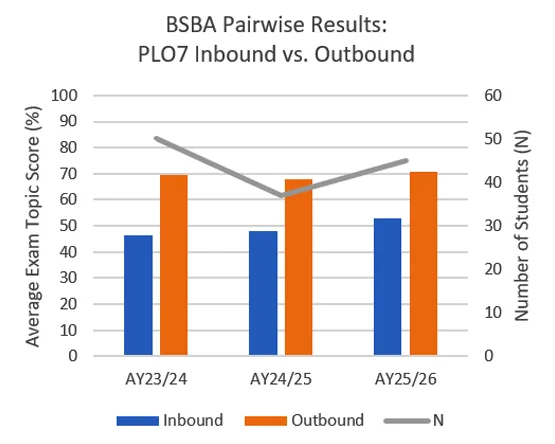
| Current Results | The average inbound score in the relevant areas 48/100. The average outbound score in the relevant areas is 68/100. This year's results show a 42% increase in students' scores as a result of completing the program (last year's increase was 49%). These are from pairwise data. |
| Analysis of Results | Results meet goals. Average outbound results are at the top of the medium category, individual students' scores increased by a large margin during their time in the program, and our outbound scores exceed those of our peer institutions. |
| Action Taken or Improvement Made | 2024-2025 is the first year that the new program learning objectives have been rolled out system wide. We will wait for another year or two of data before making any big changes. One action we have taken is 2025-2026 is the first year we are offering this program online. |
| Insert Graphs or Tables of Resulting Trends |
Image TranscriptBSBA Pairwise Results: Inbound vs. Outbound (Learning Objective 7)Description: Dual-axis chart displaying average Peregrine exam scores for PLO 7 (Global and Cultural Understanding) comparing Inbound (blue bars) and Outbound (orange bars) performance against student sample size (gray line) over three academic years. Data Breakdown
Summary: Average outbound results reach the top of the medium category (71% in 2025-2026), showing a 42% score improvement as a result of completing the program. |
Program Learning Objective 1 (PLO 1)
Objective: Students can identify, analyze and apply fundamental auditing and attestation procedures.
For this Program Learning Objective, the following performance measure was used:
- 50% Benchmark: A goal of 60% of the students scoring 50% and above.
| Performance Measure | 50% Benchmark |
|---|---|
| Instrument/Process | External, direct, formative, summative and comparative data from the Peregrine Assessment Examination. |
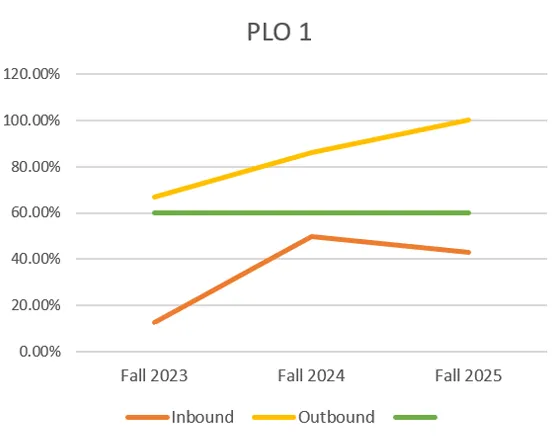
| Current Results | We have formative and summative data results for 2022, 2023, 2024 and 2025. With respect to summative data, the scores have risen from 2022 where 50% of the students met our goal to 2025 where 100% met our goal. |
| Analysis of Results | The percentage of students that have met our goal increased to 100% in 2025. We are pleased with the results and will continue to monitor this outcome. |
| Action Taken or Improvement Made | While we are pleased that the trend is positive with respect to this outcome, we will continue to monitor the results. In addition, the summative results exceeded the formative results in all four years. |
| Insert Graphs or Tables of Resulting Trends |
Image TranscriptBSBA Accounting Performance Trends, Fall 2023 to Fall 2025 (Learning Objective 1)Description: Line chart tracking student performance for Program Learning Outcome 1, comparing Inbound (orange line) and Outbound (yellow line) scores against a baseline target (60%; green line) across three fall semesters. Data Breakdown
Summary: Outbound scores exceeded the 60% benchmark target in all three terms, reaching 100% in Fall 2025. The gap between inbound baselines and outbound results demonstrates substantial learning growth throughout the program. |
Program Learning Objective 1 (PLO 1)
Objective: Students with an Emphasis in Human Resource Management will also be able to develop the business acumen needed to perform Human Resource Management transactions, employ standard operating procedure and promote operational efficiency.
For this Program Learning Objective, the following performance measure was used:
- 65% Benchmark: A goal of minimum average score of 65% on the Peregrine HR Exam and to meet or exceed the ACBSP average.
| Performance Measure | 65% Benchmark |
|---|---|
| Instrument/Process | Peregrine human resources exam. Direct, summative, comparative. |
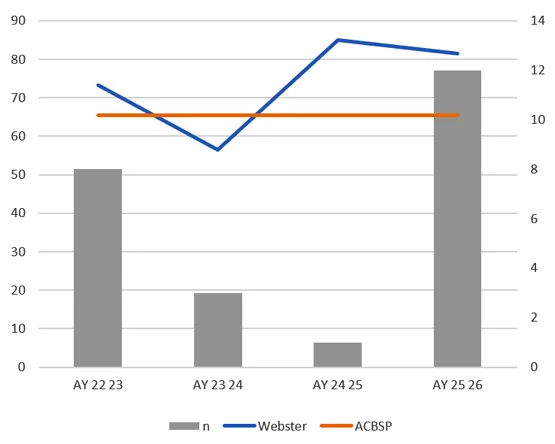
| Current Results | In 2025-2026 the outbound performance reached 81.41, up sharply from 73 in 2022-2023. Business Integration and Strategic Management led the cluster at 88.57 reversing its 2024-2025 result of 50. Management scored 78.57 and Management: Human Resource Management 76.00 (vs. 68.84). The combined HRM Advanced Topic IV score was 82.50. |
| Analysis of Results | Outbound Performance: The cluster improved from 73 to 81 was driven primarily by Business
Integration and Strategic Management. Management: Human Resource Management posts
the narrowest margin over its regional comparison of any benchmarked topic in the
program and warrants continued attention. National Performance: The regional comparison of 66.92 was exceeded across the cluster, indicating effective preparation for operationally focused HR work in both degree programs. |
| Action Taken or Improvement Made | The strategic-management components of the curriculum show clear gains this cycle. Actions for 2026-2027: (1) append inbound data when available to compute learning gains; (2) target Management: Human Resource Management content, the program's narrowest margin over the regional comparison; (3) continue SHRM-aligned, applied instruction (simulations, case studies, video lecturettes) that supported this year's improvement. |
| Insert Graphs or Tables of Resulting Trends |
Image TranscriptBSBA Human Resource Management: Performance vs. ACBSP Benchmark (Learning Objective 1)Description: Dual-axis chart tracking Webster performance scores (blue line) against the ACBSP benchmark (65.5, flat orange line) on the primary axis, alongside student sample size (n, gray bars) on the secondary axis across four academic years. Data Breakdown
Summary: Except for a dip in 2023-2024, Webster scores consistently outperformed the ACBSP benchmark (65.5), reaching a high of 85 in 2024-2025 and stabilizing at 81.5 in 2025-2026 as sample size expanded to 12. |
For these Program Learning Objectives, the following performance measure was used:
- 50% Benchmark: Overall average outbound scores should be at least 50. Overall outbound average scores should be on par with or higher than scores of other Region 5 schools.
Program Learning Objective 1 (PLO 1)
Objective: Students will be able to identify and apply appropriate terminology, facts, concepts, principles, analytic techniques and theories used in international business when analyzing moderately complex situations.
| Performance Measure | 50% Benchmark |
|---|---|
| Instrument/Process | Peregrine Assessment, Direct, formative, external. |
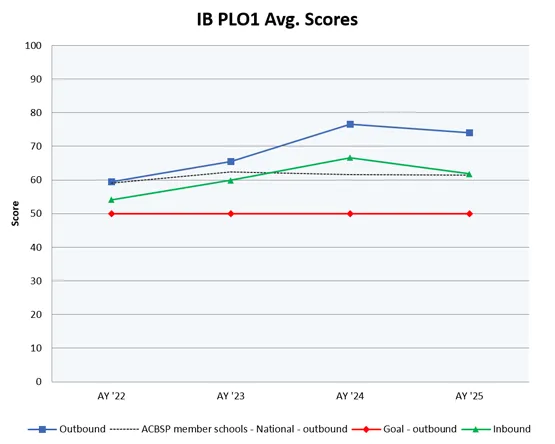
| Current Results | In 2022-2023, the outbound scores of our students was 59.391 and those of other schools in Region 5 was 59.02. We met both goals that were set. |
| Analysis of Results | The scores for this report are based on one Peregrine assessment item, Global business. There is much room for improvement and discussions are ongoing as to how best to measure our program learning outcomes. We may need both a new external tool, as well as need to put several initiatives into place to ensure increased participation among students at all locations. |
| Action Taken or Improvement Made | A meeting has been set with a third-party vendor to consider a new tool that could be implemented that may be more suitable at measuring the program learning outcomes for the International Business program. |
| Insert Graphs or Tables of Resulting Trends |
Image TranscriptBSBA International Business Average Scores (Learning Objective 1)Description: Line graph tracking assessment trends for International Business PLO 1 (identifying and applying terminology, concepts and theories in moderately complex situations) comparing Inbound, Outbound, ACBSP National Outbound benchmarks, and Goal target (50). Data Breakdown
Summary: Outbound performance consistently met and exceeded the program goal of 50, outperforming ACBSP national averages and reaching 74 in 2025-2026. |
Program Learning Objective 2 (PLO 2)
Objective: Students will be able to identify and apply appropriate terminology, facts, concepts, principles, analytic techniques and theories used in international business when analyzing moderately complex situations.
| Performance Measure | 50% Benchmark |
|---|---|
| Instrument/Process | Peregrine Assessment, Direct, formative, external. |
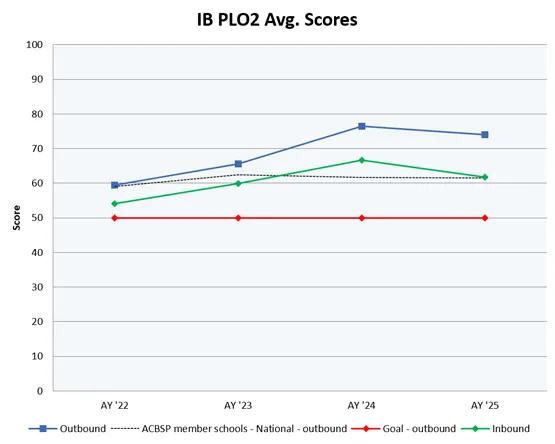
| Current Results | In 2022-2023, the outbound scores of our students was 59.391 and those of other schools in Region 5 was 59.02. We met both goals that were set. |
| Analysis of Results | The scores for this report are based on one Peregrine assessment item, Global business. There is much room for improvement and discussions are ongoing as to how best to measure our program learning outcomes. We may need both a new external tool, as well as need to put several initiatives into place to ensure increased participation among students at all locations. |
| Action Taken or Improvement Made | A meeting has been set with a third-party vendor to consider a new tool that could be implemented that may be more suitable at measuring the program learning outcomes for the International Business program. |
| Insert Graphs or Tables of Resulting Trends |
Image TranscriptBSBA International Business Average Scores (Learning Objective 2)Description: Line graph tracking assessment performance for International Business PLO 2 (applying principles and analytic techniques to complex situations) comparing Inbound, Outbound, ACBSP National Outbound and Goal target (50). Data Breakdown
Summary: Both set goals were met: outbound scores exceeded the 50-point target every year and remained on par with or above national ACBSP benchmarks, peaking at 76.5 in 2024-2025. |
Program Learning Objective 3 (PLO 3)
Objective: Students will be able to synthesize and integrate important concepts, principles and theories used in international business into solutions to moderately complex management problems.
| Performance Measure | 50% Benchmark |
|---|---|
| Instrument/Process | Peregrine Assessment, Direct, formative, external, comparative. |
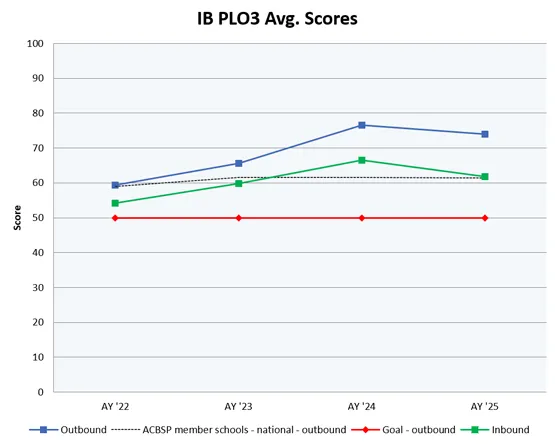
| Current Results | In 2025-2026, the outbound scores of our students was 74.04% and those of other schools in Region 5 was 61.5%. We met both goals that were set. |
| Analysis of Results | The scores for this report are based on one Peregrine assessment item, Global business. There is much room for improvement and discussions are ongoing as to how best to measure our program learning outcomes. We may need both a new external tool, as well as need to put several initiatives into place to ensure increased participation among students at all locations. |
| Action Taken or Improvement Made | We continue to look for tools that may help us get more accurate and in-depth data for the International Business emphasis. While creating an internal tool has been considered, the fact that it would not supply us with external comparative data has kept us from moving forward with it. |
| Insert Graphs or Tables of Resulting Trends |
Image TranscriptBSBA International Business Average Scores (Learning Objective 3)Description: Line graph tracking assessment performance for International Business PLO 3 (synthesizing and integrating concepts to solve management problems) across Inbound, Outbound, ACBSP National and Goal (50%) benchmarks. Data Breakdown
Summary: In 2025-2.26, outbound scores reached 74.04%, comfortably surpassing both the goal of 50 and the ACBSP national benchmark average of 61.5%. |
Program Learning Objective 1 (PLO 1)
Objective: Students will be able to demonstrate an understanding of how to identify and utilize relevant information in order to make effective marketing decisions.
For this Program Learning Objective, the following performance measure was used:
- 50% Benchmark: Students average score within upper half percentile ranking of market researched. Students’ improvement from formative to summative survey meets or exceeds peer ACBSP Schools. Outbound Student Performance meets or exceeds ACBSP Region 5 average scores.
| Performance Measure | 50% Benchmark |
|---|---|
| Instrument/Process | Peregrine Survey. Direct, Formative, Summative, External, Comparative. |
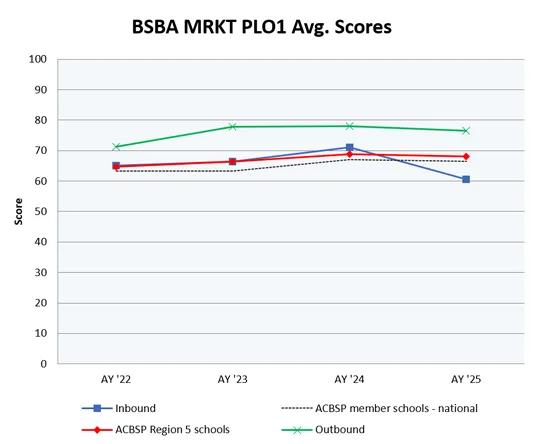
| Current Results | In 2025-2026, the outbound students scored 76% on marketing decision related questions. Other students at ACBSP member schools nationally scored 66%. Based on those comparative scores, this goal can be marked as having been met. |
| Analysis of Results | The results suggest that outbound students are demonstrating an understanding of the process of marketing and are able to make effective decisions. |
| Action Taken or Improvement Made | Continue using current evaluations methods. Standardized syllabi with information shared with all faculty and follow up emails send every semester/term to ensure all relevant courses are implementing assessment test. |
| Insert Graphs or Tables of Resulting Trends |
Image TranscriptBSBA Marketing Average Scores (Learning Objective 1)Description: Line graph displaying four-year assessment trends for Marketing PLO 1 (identifying and utilizing information for marketing decisions) across Inbound, Outbound, ACBSP Region 5 and ACBSP National benchmarks. Data Breakdown
Summary: In 2025-2026, outbound students scored 76% on marketing decision questions, exceeding the ACBSP national average (66%) and Region 5 benchmarks (68%). |
Program Learning Objective 2 (PLO 2)
Objective: Students will be able to demonstrate the ability to make and defend decisions regarding the various marketing mix elements for value creation in a way that reflects the needs and characteristics desired for organizational success and meaningful relationships among and between stakeholders.
For this Program Learning Objective, the following performance measure was used:
- 50% Benchmark: Average Score within upper half of Peregrine Survey on the 4Ps. Students’ improvement from formative to summative survey meets or exceeds peer ACBSP Schools. Outbound Student Performance meets or exceeds ACBSP Region 5 average scores.
| Performance Measure | 50% Benchmark |
|---|---|
| Instrument/Process | Peregrine Survey. Direct, Formative, Summative, External, Comparative. |
| Current Results | Students scored in the upper percentile on the 4Ps. The results on these sections (4Ps) are on average at least 10 percentile higher results from peer institutions. Students showed considerable improvement from inbound to outbound test results. |
| Analysis of Results | The results are very promising and place us well ahead of our peer schools. |
| Action Taken or Improvement Made | No changes are currently being made to this assessment. |
| Insert Graphs or Tables of Resulting Trends |
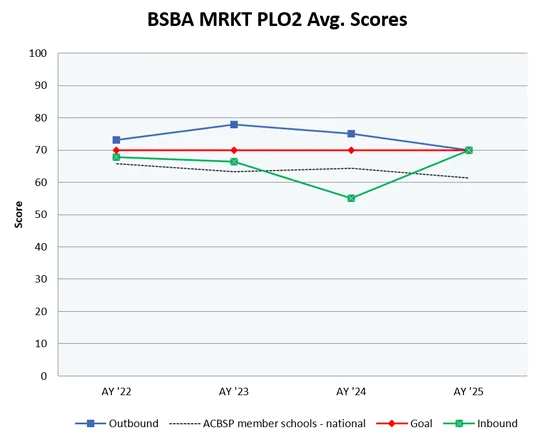
Image TranscriptBSBA Marketing Average Scores (Learning Objective 2)Description: Line graph tracking performance in Marketing PLO 2 (4Ps / marketing mix elements) across Inbound, Outbound, Institutional Goal (70%) and ACBSP National benchmarks. Data Breakdown
Summary: Outbound scores consistently exceeded national benchmarks across all years, outperforming peer institutions by up to 14 percentage points in prior cycles and matching the program goal of 70% in 2025-2026. |
Program Learning Objective 3 (PLO 3)
Objective: Students will demonstrate personal skills (i.e. ethics, teamwork, effective communication, critical thinking) which are important keys to having a successful career in marketing.
For this Program Learning Objective, the following performance measure was used:
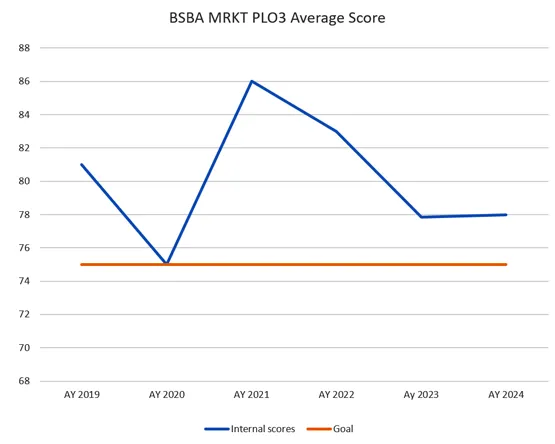
- 75% Benchmark: Students score above the 75% mark on final presentations made in the Capstone course.
| Performance Measure | 75% Benchmark |
|---|---|
| Instrument/Process | Case Analysis – final scores of decisions. Students score above the 75% mark on final presentations made in the Capstone course. (direct, formative) |
| Current Results | Students scored above the set 75% goal. |
| Analysis of Results | Students performed well in teams, though data was only made available from one section of the capstone course. |
| Action Taken or Improvement Made | There is no external data that can be used to compare the scores for this PLO. This will be discussed and addressed in the coming years. |
| Insert Graphs or Tables of Resulting Trends |
Image TranscriptBSBA Marketing Average Score Trend (Learning Objective 3)Description: Line graph showing internal Capstone case analysis decision scores for Marketing PLO 3 (personal skills: ethics, teamwork, communication, critical thinking) measured against a fixed 75% target benchmark. Data Breakdown
Summary: Internal student scores met or exceeded the 75% goal across all six evaluated years, peaking at 86% in 2021-2022 before stabilizing at 78% in 2023-2024. |
Program Learning Objective 4 (PLO 4)
Objective: Students will be able to demonstrate an understanding of mutually interdependent relationships of all the major functional areas of a business enterprise.
For this Program Learning Objective, the following performance measure was used:
- 50% Benchmark: Student scores average in upper half for Peregrine Business Integration category. Students’ improvement from formative to summative survey meets or exceeds peer ACBSP Schools. Outbound Student Performance meets or exceeds ACBSP Region 5 average scores.
| Performance Measure | 50% Benchmark |
|---|---|
| Instrument/Process | Peregrine Survey. Direct, Formative, Summative, External, Comparative. |
| Current Results | Students scored in the upper percentile on business integration. The results are higher than the results from peer institutions. |
| Analysis of Results | Students have met expectations regarding having an understanding of the mutually interdependent relationships of all business functional areas, as showcased by their scores on the integration component of the assessment. |
| Action Taken or Improvement Made | No changes are being made currently. |
| Insert Graphs or Tables of Resulting Trends |
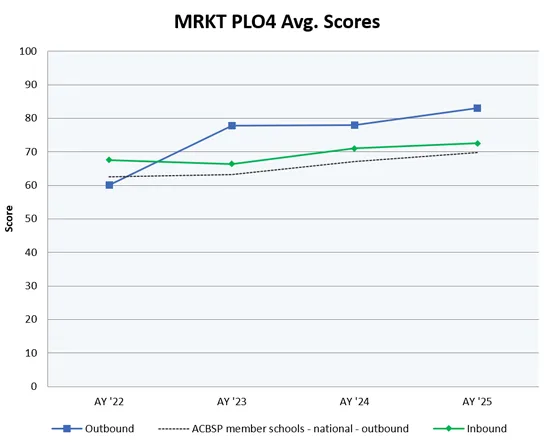
Image TranscriptBSBA Pairwise Results: Inbound vs. Outbound (Learning Objective 4)Description: Line chart tracking Business Integration performance for Marketing PLO 4 comparing Inbound, Outbound and ACBSP National Outbound benchmarks. Data Breakdown
Summary: Outbound performance steadily increased from 60 in 2022-2023 to 83 in 2025-2026, surpassing both internal inbound baselines (72) and national ACBSP member school averages (70). |
Program Learning Objective 1 (PLO 1)
Objective:
For this Program Learning Objective, the following performance measure was used:
- 4.0 Rating: Rating of at least 4.0 on all program learning outcomes.
| Performance Measure | 4.0 Rating |
|---|---|
| Instrument/Process | Summative, Internal. Internship advisors rate students performance on a 5-point scale (5 is the highest rating.) |
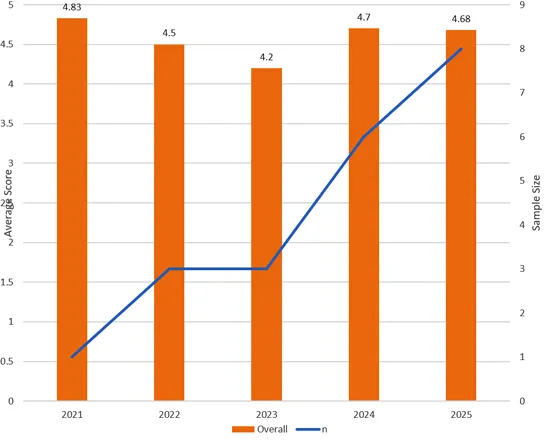
| Current Results | All 8 students exceeded a score of 4.0. The lowest was 4.19 |
| Analysis of Results | The students exceeded 4.0 average in all outcomes. The lowest average was in outcome 4 (4.38 average): Analyze the trends, opportunities and challenges to compete successfully in a rapidly changing sports and entertainment global environment. |
| Action Taken or Improvement Made | Analytical skills are emphasized in the new BSBA curriculum. We will monitor future results in this area |
| Insert Graphs or Tables of Resulting Trends |
Image TranscriptBSBA Sports and Entertainment Management (Learning Objective 1)Description: Dual-axis chart tracking overall average internship evaluation scores (orange bars) on a 5-point scale alongside student sample size (n, blue line) from 2021 to 2025, paired with the assessment findings table. Data Breakdown
Summary: All 8 students in 2025-2026 exceeded the benchmark score of 4.0, with an overall average score of 4.68. The lowest average score occurred in Outcome 4 (4.38: "Analyze trends, opportunities and challenges to compete successfully in a rapidly changing sports and entertainment global environment"). Analytical skills are emphasized in the new BSBA curriculum to support future performance in this area. |
For all Program Learning Objectives, the following performance measure was used:
- 80% Benchmark: At least 80% of the students score in the “Medium” or “High” category on the multiple choice exam.
Program Learning Objective 1 (PLO 1)
Objective: Students can apply time value of money techniques to security valuation.
| Performance Measure | 80% Benchmark |
|---|---|
| Instrument/Process | Multiple choice test in three required upper-level finance courses. Direct, formative, internal. |
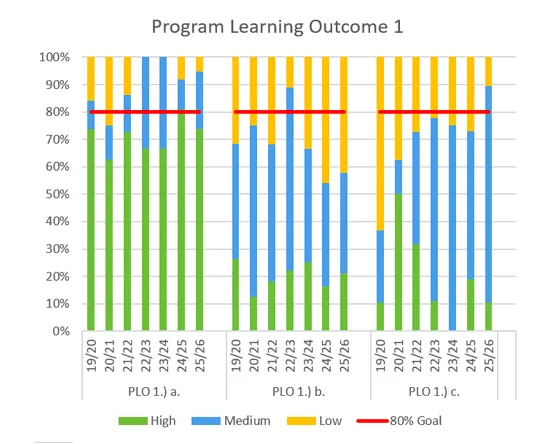
| Current Results | Please see graph. PLO 1 is divided into 3 subcategories and are provided as 1a, 1b and 1c. |
| Analysis of Results | Learning outcome 1a: “Students can solve time value of money problems” continues to show strong results staying above the 80% goal. We believe we are on track with this outcome. 1b: “Students can determine the value of fixed income securities” finally meets the goal. The trend has been worse over the last three years. 1c: “Students can determine the value of stock” this measure has reached satisfactory level. |
| Action Taken or Improvement Made | Results for PLO 1a remain strong and consistent with previous results. PLO 1b continues to be below the acceptable level. Results on bond pricing is stronger than mortgage valuation. Meanwhile, PLO 1c has finally met our goal. However, the raw data suggests that students in one class did very well on a question and poorly on the next question. We will examine the instrument to see if our assessment questions are working correctly. We initiated an online version of the assessment and this is the first trial using it, and there appears to be an error. |
| Insert Graphs or Tables of Resulting Trends |
Image TranscriptProgram Learning Outcome 1Description: A stacked bar chart showing the percentage of students achieving "High" (green), "Medium" (blue) and "Low" (yellow) performance levels across seven academic years for each of the three suboutcome goals. A red line marks the 80% benchmark. PLO 1a Learning Performance Data: Solve Time Value of Money Problems
Summary: Combined performance (High + Medium) consistently meets or exceeds the 80% benchmark across all seven academic years, with 100% combined achievement reached in 2022-2023 and 2023-2024. High achievement alone surpassed the benchmark in 2024-2025. PLO 1b Learning Performance Data: Value Fixed Income Securities
PLO 1c Learning Performance Data: Determine the Value of Stock
|
Program Learning Objective 2 (PLO 2)
Objective: Students can evaluate the financial strength of a corporation and analyze capital budgeting decisions.
| Performance Measure | 80% Benchmark |
|---|---|
| Instrument/Process | Multiple choice test in three required upper-level finance courses. Direct, formative, internal. |
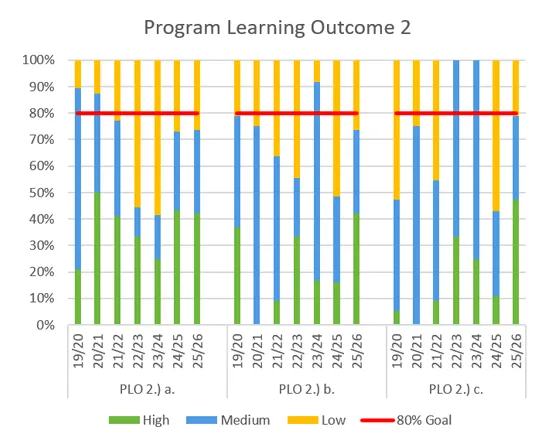
| Current Results | Please see graph. PLO 2 is divided into 3 subcategories and are provided as 2a, 2b and 2c. |
| Analysis of Results | Results for Learning Outcome 2a, on topics of NPV and IRR, were slightly below the 80% level. Results for Learning outcome 2b "Students can utilize ratio analysis to assess an organization's financial condition" shows some improvement. Results for the Learning Outcome 2c are much better after we adjusted the assessment questions to be a better specification of our outcome. |
| Action Taken or Improvement Made | We adjusted some questions in regard to PLO 2b and 2c beginning in the 2023-2024 year. Below our goal, there was no change in PLO 2a. PLO 2b continues to bounce around, but is still below goal. 2c approaches our goal. |
| Insert Graphs or Tables of Resulting Trends |
Image TranscriptProgram Learning Outcome 2Description: A stacked bar chart showing the percentage of students achieving "High" (green), "Medium" (blue) and "Low" (yellow) performance levels across seven academic years for each of the three suboutcome goals. A red line marks the 80% benchmark. PLO 2a Learning Performance Data
PLO 2b Learning Performance Data
PLO 2c Learning Performance Data
|
Program Learning Objective 3 (PLO 3)
Objective: Students can understand the risk-return relationship and can estimate appropriate rates of return.
| Performance Measure | 80% Benchmark |
|---|---|
| Instrument/Process | Multiple choice test in three required upper-level finance courses. Direct, formative, internal. |
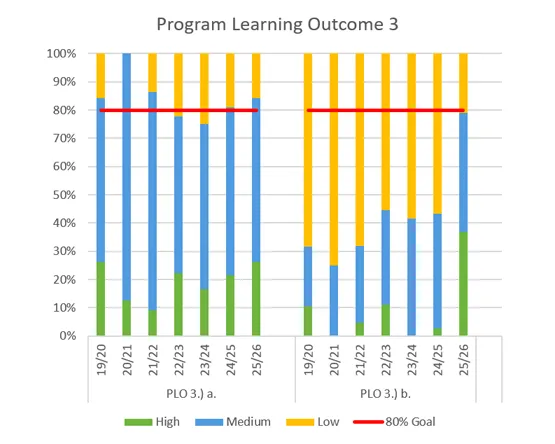
| Current Results | Please see graph. PLO 3 is divided into 2 subcategories and are provided as 3a and 3b. |
| Analysis of Results | Learning Outcome 3a: “Students can identify determinants of interest rates and specify how they affect required returns of securities” saw a slight increase in performance, but is just above the target. Learning Outcome 3b: “Students can estimate required rate of return” is approaching the 80% goal. |
| Action Taken or Improvement Made | Results for PLO 3a remain strong with students showing good understanding of the relation of interest rates to expectations of future rates and pricing. We will see how results are in the next couple terms. We changed the assessment to an online format for the first time and need a couple more results of students performance. |
| Insert Graphs or Tables of Resulting Trends |
Image TranscriptProgram Learning Outcome 3Description: A stacked bar chart showing the percentage of students achieving "High" (green), "Medium" (blue) and "Low" (yellow) performance levels across seven academic years for each of the two suboutcome goals. A red line marks the 80% benchmark. PLO 3a Learning Performance Data
PLO 3b Learning Performance Data
|
Program Learning Objective 4 (PLO 4)
Objective: Students can describe the intermediation services provided by financial institutions.
| Performance Measure | 80% Benchmark |
|---|---|
| Instrument/Process | Multiple choice test in three required upper-level finance courses. Direct, formative, internal. |
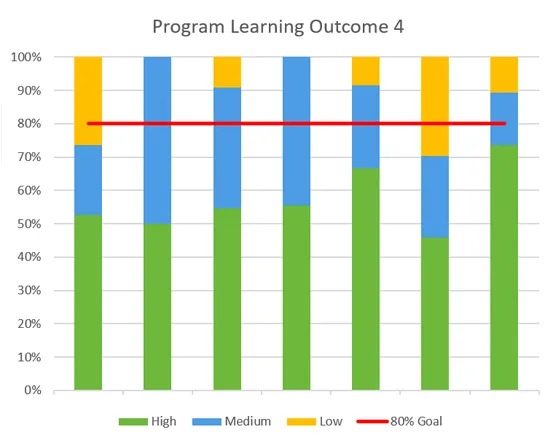
| Current Results | Please see graph. |
| Analysis of Results | Learning Outcome 4: “Students can describe the intermediation services provided by financial institutions” has exceeded the 80% goal for five of the last six years. The results are satisfactory for this PLO. |
| Action Taken or Improvement Made | No actions taken at this time. Results have been strong. |
| Insert Graphs or Tables of Resulting Trends |
Image TranscriptProgram Learning Outcome 4Description: A stacked bar chart showing the percentage of students achieving "High" (green), "Medium" (blue) and "Low" (yellow) performance levels across seven academic years. A red line marks the 80% benchmark. PLO 4 Learning Performance Data
|
Graduate Programs: Measurement and Analysis of Student Learning and Performance
For all Program Learning Objectives, the following performance measure was used:
- 80% Benchmark: At least 80% of the students score in the “Moderate” or “Good” category on the the assessment case study.
Program Learning Objective 1 (PLO 1)
Objective: Students will be able to explain the important terminology, facts, concepts, principles, analytic techniques and theories used in human resources management.
| Performance Measure | 80% Benchmark |
|---|---|
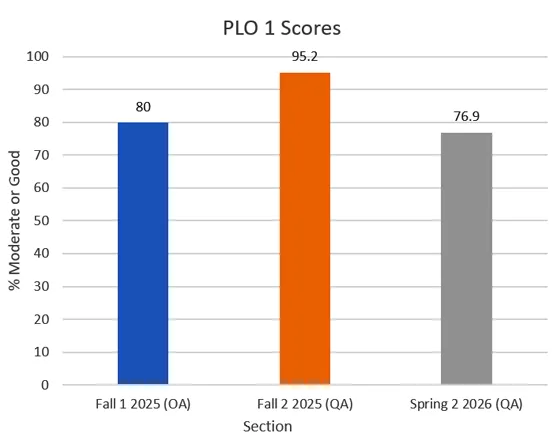
| Instrument/Process | The instrument used is the Week 4 Outline and Annotated Bibliography assignment in the capstone course, HRMG 6000, which is a direct, formative and internal instrument. This assignment requires students to summarize and evaluate peer-reviewed HR literature in an annotated bibliography and organize their final project plan into a formal outline, directly evidencing command of HR terminology, concepts, and theories. Ten students were assessed in Fall 1 2025 (OA), 21 students were assessed in Fall 2 of 2025 (QA), and 13 students were assessed in Spring 2 of 2026 (QA). |
| Current Results | As the chart indicates, results for PLO 1 were mixed across the current assessment cycle. In Fall 1 and 2 2025 we saw section averages of 80% (OA) and 95.2% (QA) of students achieving “moderate” or “good” on this learning outcome. In Spring 2 2026 we saw 76.9% of students achieve “moderate” or “good,” falling below our 80% goal. |
| Analysis of Results | While the Fall 2 2025 QA section exceeded our goal, the Fall 1 2025 OA and Spring 2026 QA sections fell at or below the 80% threshold, indicating inconsistent student command of HR terminology, concepts and theories at the literature-review stage of the capstone project. |
| Action Taken or Improvement Made | We will review the Week 4 Outline and Annotated Bibliography assignment guidance and rubric to ensure expectations for literature engagement are clear, and will consider adding an early formative check-in or exemplar annotated bibliography to better scaffold this skill before the Outline is due. |
| Insert Graphs or Tables of Resulting Trends |
Image TranscriptMA Human Resources Management PLO 1Description: A bar chart displaying student performance at Moderate or Good levels for Program Learning Objective 1 across three terms during the 2025-2026 academic year. Each section is color-coded: blue for Fall 1 2025 (OA), orange for Fall 2 2025 (QA), and gray for Spring 2 2026 (QA). Data
|
Program Learning Objective 2 (PLO 2)
Objective: Students will be able to effectively apply important terminology, facts, concepts, principles, analytic techniques and theories used in human resources management when analyzing situations.
- Identifies important topics and issues;
- Identifies and correctly applies relevant concepts and theories in the analysis;
- Supports conclusions or claims with relevant facts and sound reasoning.
| Performance Measure | 80% Benchmark |
|---|---|
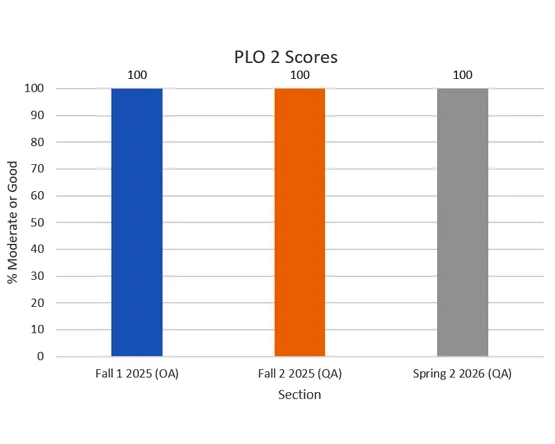
| Instrument/Process | The instrument used is the Week 8 Final Case Study (Northrop Grumman) assignment in the capstone course, HRMG 6000, which is a direct, summative and internal instrument. This assignment requires students to analyze a real-world HR/M&A scenario and apply relevant HR concepts and theories to evaluate the organization's practices and support recommendations with outside references, directly evidencing the application sub-criteria of this outcome (2a, 2b, 2c). Ten students were assessed in Fall 1 2025 (OA), 21 students were assessed in Fall 2 2025 (QA), and 13 students were assessed in Spring 2 2026 (QA). |
| Current Results | Results for PLO 2 were strong and consistent across the cycle. Section averages of 100% of students achieved “moderate” or “good” on this learning outcome. |
| Analysis of Results | All sections assessed exceeded our goal of 80% of students achieving “moderate” or “good,” indicating students are effectively applying HR concepts and theories when analyzing the Final Case Study. |
| Action Taken or Improvement Made | No corrective action is needed at this time. We will continue to monitor performance on this outcome to ensure it remains strong and that the case materials remain rigorous. |
| Insert Graphs or Tables of Resulting Trends |
Image TranscriptMA Human Resources Management PLO 2Description: A bar chart displaying Moderate or Good student performance for three sub-objectives of PLO 2 (2A, 2B, and 2C) across three term sections during the 2025-2026 academic year. Each section is color-coded: blue for Fall 1 2025 (OA), orange for Fall 2 2025 (QA) and gray for Spring 2 2026 (QA). Data
|
Program Learning Objective 3 (PLO 3)
Objective: Students will be able to effectively integrate important facts, concepts, principles and theories used in human resources management when developing solutions or analyzing situations.
| Performance Measure | 80% Benchmark |
|---|---|
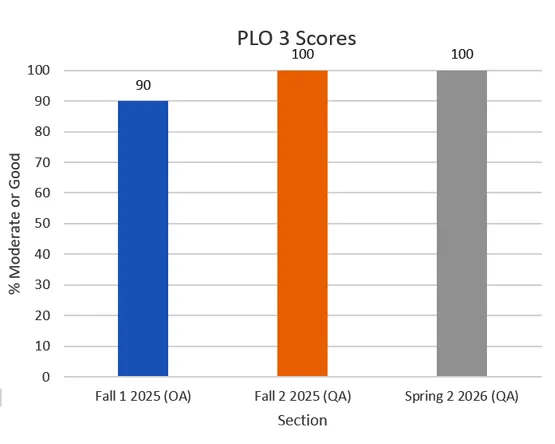
| Instrument/Process | The instrument used is the Week 9 Final Paper assignment in the capstone course, HRMG 6000, which is a direct, summative and internal instrument. This capstone paper requires students to integrate HR concepts, theories and evidence from multiple sources into a cohesive analysis, including a dedicated recommendations chapter, directly evidencing the ability to synthesize material into an original, evidence-based, actionable solution. Ten students were assessed in Fall 1 2025 (OA), 21 students were assessed in Fall 2 2025 (QA), and 13 students were assessed in Spring 2 2026 (QA). |
| Current Results | Results for PLO 3 showed improvement over the cycle. In Fall 1 and 2 2025 we saw section averages of 90% (OA) and 100% (QA) of students achieving “moderate” or “good.” In Spring 2 2026, 100% of students achieved “moderate” or “good.” |
| Analysis of Results | All sections assessed met or exceeded our goal of 80%, with the most recent section (Spring 2 2026) reaching full attainment, suggesting students are increasingly able to integrate HR concepts and theory into actionable, evidence-based recommendations in the Final Paper. |
| Action Taken or Improvement Made | We will continue to reinforce the recommendations chapter requirement in the Final Paper guidance, as it appears to be effectively driving integrative thinking. |
| Insert Graphs or Tables of Resulting Trends |
Image TranscriptMA Human Resources Management PLO 3Description: A bar chart displaying student performance at Moderate or Good levels for Program Learning Objective 3 across three terms during the 2025-2026 academic year. Each section is color-coded: blue for Fall 1 2025 (OA), orange for Fall 2 2025 (QA), and gray for Spring 2 2026 (QA). Data
|
Program Learning Objective 1 (PLO 1)
Objective: Students will demonstrate proficiency in group dynamics, collaboration, interpersonal relations and leading individuals, teams or organizations.
For this Program Learning Objective, the following performance measure was used:
- 60% Benchmark: 60% overall mean post-test score (met) and significant improvement over mean pre-test
score (met).
- At least 70% of students scoring 60% and above (met).
- Overall mean score equal to or above the national mean score (met).
| Performance Measure | 60% Benchmark |
|---|---|
| Instrument/Process | Capsim ModExam Test — direct, formative, external, comparative. |
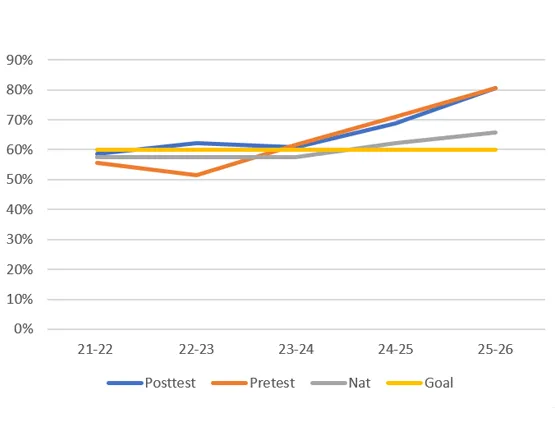
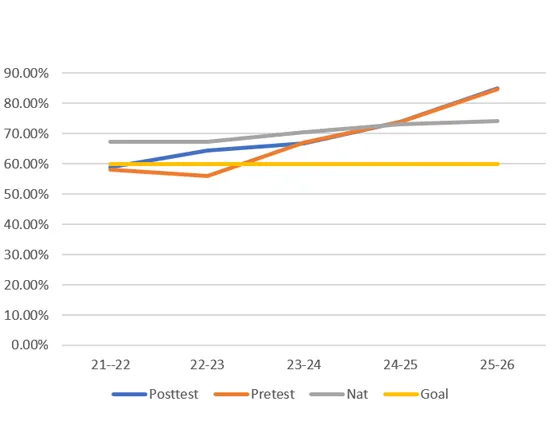
| Current Results | All four goals met, several by the widest margin in five years. Post-test mean 80.70% (goal: 60%). Exceeded national mean (65.76%) by 14.94 pts. 89.3% of students scored ≥60% (goal: 70%). Post-test exceeded pre-test by only +0.20 pts — pre-test itself jumped to 80.50%. |
| Analysis of Results | Improvement was broad-based — every score threshold rose vs. 2024-2025, with the top end (>90%) nearly tripling to 38.2%. But the pre-test mean rose 17.5 pts over last year, nearly closing the pre/post gap. Possible causes: stronger incoming cohort, instrument/administration change or an emerging ceiling effect (pre-test was also volatile in 2023-2024). |
| Action Taken or Improvement Made | Continued emphasis on decision-making instruction consistent with prior curriculum work; program performance remains well above goal and the national benchmark. Assessment will continue to be monitored as part of ongoing program review. |
| Insert Graphs or Tables of Resulting Trends |
Image TranscriptPLO 1 ResultsDescription: A line graph tracking student performance percentages over five academic years. The chart compares the program's Post-test score (blue line), Pre-test score (orange line), and National Mean (gray line) against a 60% Benchmark Goal (yellow horizontal line). Data
Summary: Student performance met all target goals for 2025-2026, with the Post-test mean reaching 80.70%, exceeding the 60% benchmark goal and outperforming the national mean (65.76%) by nearly 15 percentage points. While both pre-test and post-test scores have shown strong upward trajectories over the five-year period, the pre-test mean rose substantially in recent cycles (80.50% in 2025-2026), nearly closing the pre/post performance gap. |
Program Learning Objective 2 (PLO 2)
Objective: Students will demonstrate proficiency in complex problem-solving skills, logical reasoning and idea generation for making strategic business-related decisions.
For this Program Learning Objective, the following performance measure was used:
- 60% Benchmark: 60% overall mean post-test score (met) and significant improvement over mean pre-test
score (met).
- At least 70% of students scoring 60% and above (met).
- Overall mean score equal to or above the national mean score (met).
| Performance Measure | 60% Benchmark |
|---|---|
| Instrument/Process | Capsim ModExam — direct, formative, external, comparative. |
| Current Results | All goals met, each by the widest margin in five years. Post-test mean 84.90% (goal: 60%). Exceeded national mean (74.15%) by 10.75 pts — the first year leading the national comparator by a wide margin. 95.7% of students scored ≥60% (goal: 70%). |
| Analysis of Results | Improvement was broad-based across the score distribution, and this is the first year the program has decisively led the national mean after trailing it in three of the prior four years. |
| Action Taken or Improvement Made | Continued emphasis on decision-making and strategic problem-solving instruction consistent with prior curriculum work; program performance remains well above goal and the national benchmark. Assessment will continue to be monitored as part of ongoing program review. |
| Insert Graphs or Tables of Resulting Trends |
Image TranscriptPLO 2 ResultsDescription: A line graph tracking student performance percentages over five academic years. The chart compares the program's Post-test score (blue line), Pre-test score (orange line), and National Mean (gray line) against a 60% Benchmark Goal (yellow horizontal line). Data
Summary: Student performance for PLO 2 demonstrates a consistent upward trajectory over the five-year period. Combined scores have steadily climbed well above the 60% benchmark goal since 2022-2023, ultimately reaching a peak of 85% in 2025-2026 and surpassing the national mean (74.2%). Similar to PLO 1, pre-test performance has tracked almost identically with post-test scores in recent cycles. |
Program Learning Objective 3 (PLO 3)
Objective: Students will demonstrate proficiency in managerial finance, accounting, marketing, operations and human resources, as well as the capacity to synthesize and apply this functional knowledge for decision making.
For this Program Learning Objective, the following performance measure was used:
- 60% Benchmark: 60% overall mean post-test score (met) and significant improvement over mean pre-test
score (met).
- At least 70% of students scoring 60% and above (met).
- Overall mean score equal to or above the national mean score (met).
| Performance Measure | 60% Benchmark |
|---|---|
| Instrument/Process | Capsim ModExam — direct, formative, external, comparative. |
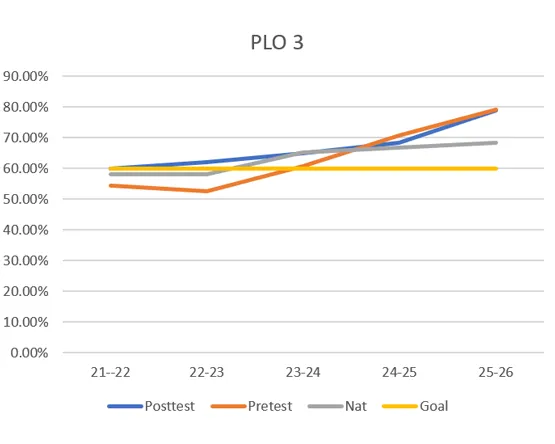
| Current Results | All goals fully met in 2025-2026 (a change from 2024-2025, when the 70%-above-60% goal was only partially met at 68%). Post-test mean 79.00% (goal: 60%). Exceeded national mean (68.35%) by 10.65 pts. 91.4% of students scored ≥60%. |
| Analysis of Results | Improvement was broad-based across the score distribution, resolving the shortfall from 2024-2025. |
| Action Taken or Improvement Made | Continued the BUSN 5100 revision undertaken to better align the course with this learning outcome; performance now exceeds both the internal goal and the national benchmark by the widest margin on record. |
| Insert Graphs or Tables of Resulting Trends |
Image TranscriptMA Management and Leadership PLO 3Description: A line graph tracking student performance percentages over five academic years. The chart compares the program's Post-test score (blue line), Pre-test score (orange line), and National Mean (gray line) against a 60% Benchmark Goal (yellow horizontal line). Data
Summary: Performance for PLO 3 has consistently met or exceeded the 60.00% benchmark goal across all five academic years. Both pre-test and post-test scores have shown significant growth since 2022-2023, reaching peak levels of nearly 79% in 2025-2026 and comfortably outperforming the national mean (68.3%). |
Program Learning Objective 4 (PLO 4)
Objective: Students will demonstrate proficiency in statistical and other mathematical techniques, data analysis and quantitative modeling of business-related information to construct solutions for management and leadership problems.
For this Program Learning Objective, the following performance measure was used:
- 60% Benchmark: 60% overall mean post-test score (met) and significant improvement over mean pre-test
score (met).
- At least 70% of students scoring 60% and above (met).
- Overall mean score equal to or above the national mean score (met).
| Performance Measure | 60% Benchmark |
|---|---|
| Instrument/Process | Capsim ModExam — direct, formative, external, comparative. |
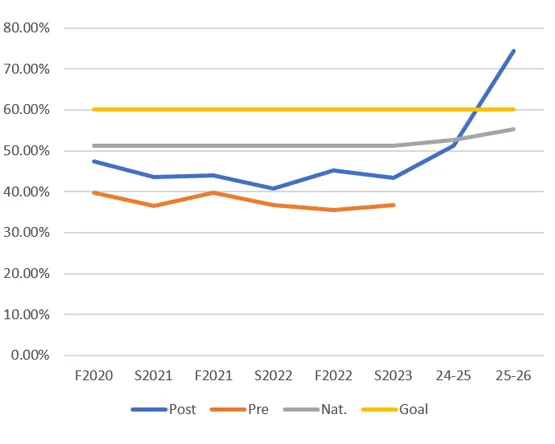
| Current Results | All four goals met for the first time in six years of data. Post-test mean 74.47% (goal: 60%). Exceeded national mean (55.16%) by 19.31 pts. 76.6% of students scored ≥60% (goal: 70%). Post-test exceeded pre-test by +4.68 pts, a genuine positive gain. |
| Analysis of Results | This is a genuine turnaround after trailing the national mean and the 60% goal in every prior period on record; improvement was broad-based across the score distribution. Note: an alternate item-level averaging method gives a different reading (pre-test 77.01% / post-test 71.50%, a negative gap) due to PLO4’s small and uneven semester sample sizes — worth settling on one standard aggregation method going forward. |
| Action Taken or Improvement Made | Continued investment in the curriculum area supporting this outcome; 2025-2026 marks the first year all four goal criteria were met. Assessment will continue to be monitored as part of ongoing program review. |
| Insert Graphs or Tables of Resulting Trends |
Image TranscriptMA Management and Leadership PLO 4Description: A line graph tracking student performance percentages over five academic years. The chart compares the program's Post-test score (blue line), Pre-test score (orange line), and National Mean (gray line) against a 60% Benchmark Goal (yellow horizontal line). Data
Summary: After a prolonged period of remaining below both the national mean and the 60.00% benchmark goal from Fall 2020 through Spring 2023 (averaging 40-47%), student performance on PLO 4 experienced a sharp upward surge in recent cycles. In 2025-2026, the post-test score jumped significantly to 74.5%, successfully surpassing both the national benchmark (55.2%) and the target goal line. Pre-test data collection ceased following the Spring 2023 term. |
For all Program Learning Objectives, the following performance measure was used:
- 80% Benchmark: The assessment goal is to have 80% of students rated as 2 (Moderate) or 3 (High) on a scale of 0-3 based on the results of an assessment exam.
Program Learning Objective 1 (PLO 1)
Objective: Students will be able to explain the important terminology, facts, concepts, principles, analytic techniques and theories used in the field of procurement and acquisitions management.
| Performance Measure | 80% Benchmark |
|---|---|
| Instrument/Process | A multiple-choice test. Direct, summative, internal, comparative data. |
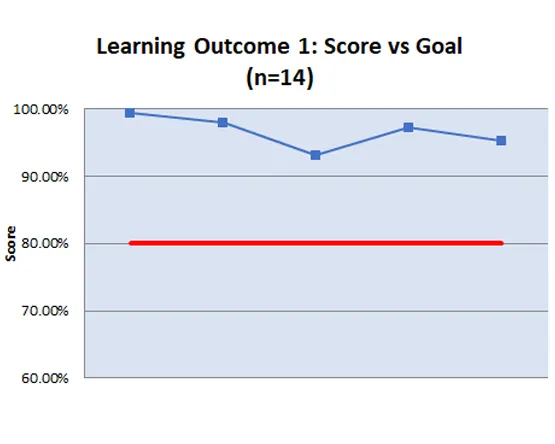
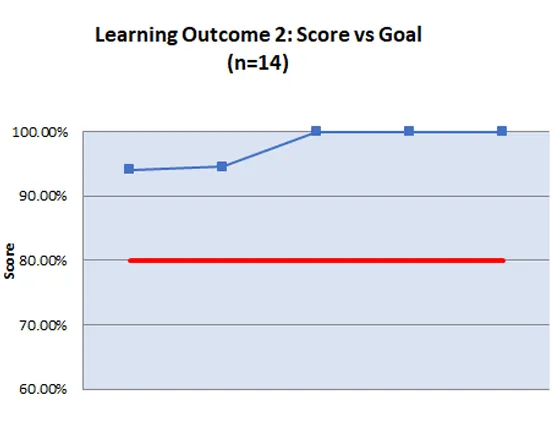
| Current Results | A goal of 80% was set as a benchmark. 85.7% of the students are rated at a 2 (Moderate) or 3 (High) on a scale of 0-3 for dimension (dim) 2. For all the other eight dimensions (dims) rated, at least 92.9% of the students are rated at a 2 (Moderate) or 3 (High) on a scale of 0-3. The student average of the aggregated measure for all dimensions is 2.61. |
| Analysis of Results | Data and results suggest that course contents remain aligned with learning objective. |
| Action Taken or Improvement Made | No action, the program will be transitioned into a supply chain degree program. |
| Insert Graphs or Tables of Resulting Trends |
Image TranscriptMA PROC PLO 1: Student Learning ResultsDescription: A line graph displaying student performance scores for Learning Outcome 1 across five measurement periods for a sample size of n=14. The blue line tracks student scores, while a red horizontal line represents the 80.00% benchmark goal. Data
|
Program Learning Objective 2 (PLO 2)
Objective: Students will be able to effectively apply important terminology, facts, concepts, principles, analytic techniques and theories used in the field of procurement and acquisitions management when analyzing complex factual situations.
| Performance Measure | 80% Benchmark |
|---|---|
| Instrument/Process | A case study. Direct, summative, internal, comparative data. |
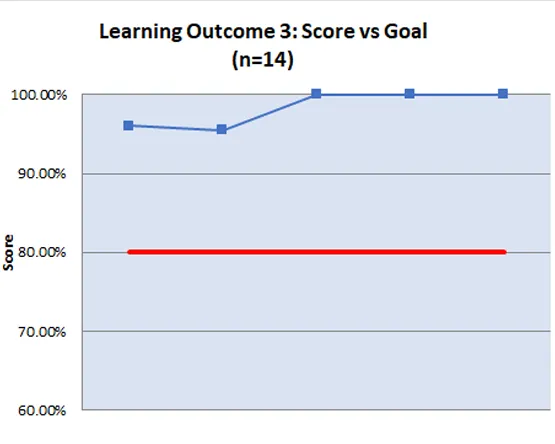
| Current Results | A goal of 80% was set as a benchmark. For both dimensions (Dims) rated, 100% of students are rated at a 2 (Moderate) or 3 (High) on a scale of 0-3. The student average of the aggregated measure for all dimensions is 2.93. |
| Analysis of Results | Data and results suggest that course contents remain aligned with learning objective. |
| Action Taken or Improvement Made | No action, the program will be transitioned into a supply chain degree program. |
| Insert Graphs or Tables of Resulting Trends |
Image TranscriptMA PROC PLO 2: Student Learning ResultsDescription: A line graph displaying student performance scores for Learning Outcome 2 across five measurement periods for a sample size of n=14. The blue line tracks student scores, while a red horizontal line marks the 80.00% benchmark goal.Data
|
Program Learning Objective 3 (PLO 3)
Objective: Students will be able to effectively integrate (or synthesize) important facts, concepts, principles and theories in the field of procurement and acquisitions management when developing solutions to multifaceted procurement and acquisitions management problems in complex factual situations.
| Performance Measure | 80% Benchmark |
|---|---|
| Instrument/Process | A case study. Direct, summative, internal, comparative data. |
| Current Results | A goal of 80% was set as a benchmark. For both dimensions (Dims) rated, 100% of students are rated at a 2 (Moderate) or 3 (High) on a scale of 0-3. The student average of the aggregated measure for all dimensions is 2.93. |
| Analysis of Results | Data and results suggest that course contents remain aligned with learning objective. |
| Action Taken or Improvement Made | No action, the program will be transitioned into a supply chain degree program. |
| Insert Graphs or Tables of Resulting Trends |
Image TranscriptMA PROC - PLO 3: Student Learning ResultsDescription: A line graph displaying student performance scores for Learning Outcome 3 across five measurement periods for a sample size of n=14. The blue line tracks student scores, while a red horizontal line marks the 80.00% benchmark goal.Data
|
For all Program Learning Objectives, the following three performance measures were used:
- 80% Benchmark: 80% of students will achieve High or Medium High.
- Score Trend: Student scores will show an upward trend on the related Peregrine subject matter areas.
- Pairwise Improvement: Student Pairwise results will show improvement between MBA 5010 and MBA 5910.
Program Learning Objective 1 (PLO 1)
Objective: Students can identify activities that align organizational ability with market opportunities to create value for relevant stakeholders.
| Performance Measure | 80% Benchmark | Score Trend | Pairwise Improvement |
|---|---|---|---|
| Instrument/Process | Analysis of written response to case analysis in the MBA 5910 capstone course — Summative, Direct, Internal | Review and analysis of Peregrine results — Summative, Direct, External, Comparison. | Review and analysis of Peregrine results — Summative, Direct, External, Comparison. |
| Current Results | Every semester the scores have exceeded our benchmark. In Spring 2026, 97.2% of students (n=106) achieved High or Medium High, continuing the strong performance across all measurement periods. | The results have been erratic with dips in Spring 2023 and Spring 2024, but have shown consistent improvement through the 2024-2025 academic year and into Spring 2026, where the Business Integration and Strategic Management subject score reached 80.2 (n=161). | With the exception of the first term (small sample), students show consistent improvement over their MBA career. In Spring 2026, the pairwise improvement in Strategic Management was +24.5 percentage points (n=152), continuing a positive trend. |
| Analysis of Results | The results are satisfactory. | The results are improving but we we will continue to monitor. | The results are satisfactory and so no action will be taken. |
| Action Taken or Improvement Made | No changes were required. | No changes were required. | The sample size for the first term was very small and therefore can be ignored. It is worth noting that the veracity of results was in question. Peregrine has adjusted their testing process to correct for this. |
Insert Graphs or Tables of Resulting Trends
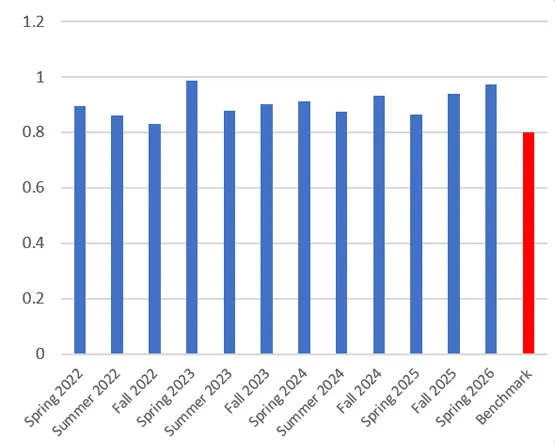
Image Transcript
MBA PLO 1: Alignment of Organizational Ability with Market Opportunities
Description: Bar chart comparing semester-by-semester student achievement rates (blue bars) against the program benchmark of 0.80 / 80% (red bar) based on written case analysis in the MBA 5910 capstone course.
Data by Semester & Sample Size (n)
- Spring 2022: 0.895 (89.5%) | n = 19
- Summer 2022: 0.859 (85.9%) | n = 64
- Fall 2022: 0.829 (82.9%) | n = 41
- Spring 2023: 0.986 (98.6%) | n = 72
- Summer 2023: 0.879 (87.9%) | n = 33
- Fall 2023: 0.903 (90.3%) | n = 103
- Spring 2024: 0.913 (91.3%) | n = 103
- Summer 2024: 0.875 (87.5%) | n = 40
- Fall 2024: 0.931 (93.1%) | n = 102
- Spring 2025: 0.864 (86.4%) | n = 81
- Fall 2025: 0.941 (94.1%) | n = 101
- Spring 2026: 0.972 (97.2%) | n = 106
Summary: Student achievement consistently exceeded the 80% benchmark across every evaluated term from Spring 2022 to Spring 2026, reaching 97.2% (n=106) in Spring 2026. Because results remained satisfactory, no curricular changes were required.
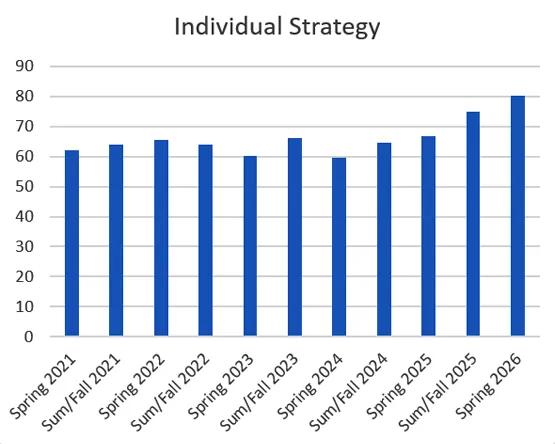
Image Transcript
MBA PLO 1: Individual Strategy Peregrine Exam Trends
Description: Bar chart displaying Peregrine external assessment scores in Strategic Management and Business Integration across 11 reporting terms from Spring 2021 through Spring 2026.
Data by Semester and Sample Size (n)
- Spring 2021: 62.0 | n = 15
- Summer/Fall 2021: 64.0 | n = 111
- Spring 2022: 65.5 | n = 109
- Summer/Fall 2022: 64.0 | n = 166
- Spring 2023: 60.0 | n = 108
- Summer/Fall 2023: 66.0 | n = 147
- Spring 2024: 59.5 | n = 112
- Summer/Fall 2024: 64.5 | n = 162
- Spring 2025: 67.0 | n = 119
- Summer/Fall 2025: 75.0 | n = 190
- Spring 2026: 80.2 | n = 161
Summary: Following earlier dips in Spring 2023 and Spring 2024, scores demonstrated consistent upward improvement through the 2024-2025 academic year and into Spring 2026, reaching a peak of 80.2 (n=161).
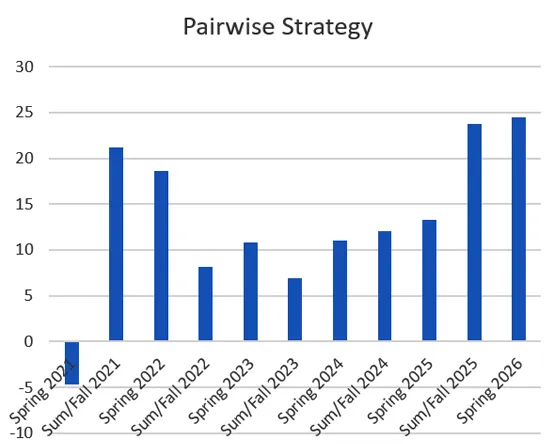
Image Transcript
MBA PLO 1: Pairwise Strategy Score Improvement
Description: Bar chart showing net pairwise percentage point changes in Strategic Management between entry (MBA 5010) and capstone completion (MBA 5910) across 11 evaluation periods.
Data by Semester and Sample Size (n)
- Spring 2021: -4.8 points | n = 22
- Summer/Fall 2021: +21.2 points | n = 132
- Spring 2022: +18.6 points | n = 136
- Summer/Fall 2022: +8.1 points | n = 212
- Spring 2023: +10.8 points | n = 120
- Summer/Fall 2023: +6.9 points | n = 174
- Spring 2024: +11.0 points | n = 103
- Summer/Fall 2024: +12.1 points | n = 154
- Spring 2025: +13.3 points | n = 112
- Summer/Fall 2025: +23.7 points | n = 181
- Spring 2026: +24.5 points | n = 152
Summary: With the exception of the small initial sample in Spring 2021 (n=22), pairwise results reflect consistent learning growth over students' MBA tenure, reaching a +24.5 percentage point increase (n=152) in Spring 2026.
Program Learning Objective 2 (PLO 2)
Objective: Students can identify opportunities to improve internal processes toward the goal of increasing operational efficiency, market reach and/or customer satisfaction.
| Performance Measure | 80% Benchmark | Score Trend | Pairwise Improvement |
|---|---|---|---|
| Instrument/Process | Analysis of written response to case analysis in the MBA 5910 capstone course — Summative, Direct, Internal. | Review and analysis of Peregrine results — Summative, Direct, External, Comparison. | Review and analysis of Peregrine results — Summative, Direct, External, Comparison. |
| Current Results | After the first measurement period, scores have exceeded the benchmark and have been improving. In Spring 2026, 96.2% of students (n=105) achieved High or Medium High. | For most of the study period, the trend was upward. There was a drop in Spring 2024, but results have since recovered and improved substantially in Spring 2026 across all subjects: Communications=84.5, Leadership=79.3, MIS=76.3, Management=78.4, HRM=73.4, Operations=78.0, Org Behavior=83.5, Marketing=81.0 (n=161). | The first term showed negative results. With one exception, the remaining observations showed improved performance between 5010 and 5910. In Spring 2026, all subjects showed positive pairwise improvement. The previous concern about declining improvements in Leadership, MIS, and Marketing has reversed. |
| Analysis of Results | The results were satisfactory. | The drop off in spring of 2024 was concerning. But the subsequent improvement is hopeful. | The results were satisfactory. |
| Action Taken or Improvement Made | No change is required. | No change is required. | No change is required. |
Insert Graphs or Tables of Resulting Trends
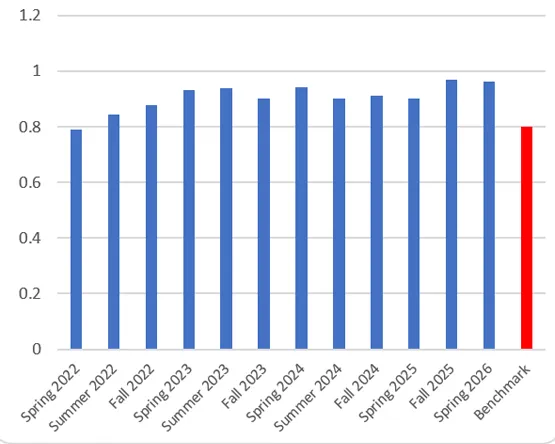
Image Transcript
MBA PLO 2: Operational Efficiency and Internal Process Improvement
Description: Bar chart tracking the percentage of students achieving High or Medium High performance on written case analysis in MBA 5910 (blue bars) relative to the 0.80 (80%) program benchmark (red bar) across 12 terms.
Data by Semester & Sample Size (n)
- Spring 2022: 0.789 (78.9%) | n = 19
- Summer 2022: 0.844 (84.4%) | n = 64
- Fall 2022: 0.878 (87.8%) | n = 41
- Spring 2023: 0.931 (93.1%) | n = 72
- Summer 2023: 0.939 (93.9%) | n = 33
- Fall 2023: 0.903 (90.3%) | n = 103
- Spring 2024: 0.942 (94.2%) | n = 103
- Summer 2024: 0.900 (90.0%) | n = 40
- Fall 2024: 0.912 (91.2%) | n = 102
- Spring 2025: 0.901 (90.1%) | n = 81
- Fall 2025: 0.970 (97.0%) | n = 101
- Spring 2026: 0.962 (96.2%) | n = 105
Summary: Following the first measurement term (Spring 2022), scores consistently exceeded the 80% benchmark and maintained an upward trend, reaching 96.2% (n=105) in Spring 2026.
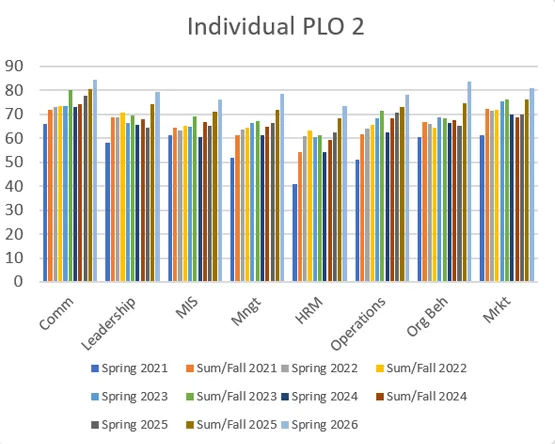
Image Transcript
MBA PLO 2: Individual Peregrine Subject Area Performance
Description: Clustered column chart showing score distribution across eight academic subjects (Comm, Leadership, MIS, Mngt, HRM, Operations, Org Beh, Mrkt) across 11 measurement periods from Spring 2021 through Spring 2026. The Y-axis scales from 0 to 90.
Data Breakdown
- Communications: Increased from 66 in Spring 2021 to 84.5 in Spring 2026.
- Leadership: Increased from 58 in Spring 2021 to 79.3 in Spring 2026.
- MIS: Increased from 61 in Spring 2021 to 76.3 in Spring 2026.
- Management: Increased from 52 in Spring 2021 to 78.4 in Spring 2026.
- HRM: Increased from 41 in Spring 2021 to 73.4 in Spring 2026.
- Operations: Increased from 51 in Spring 2021 to 78.0 in Spring 2026.
- Organizational Behavior: Increased from 61 in Spring 2021 to 83.5 in Spring 2026.
- Marketing: Increased from 61 in Spring 2021 to 81.0 in Spring 2026.
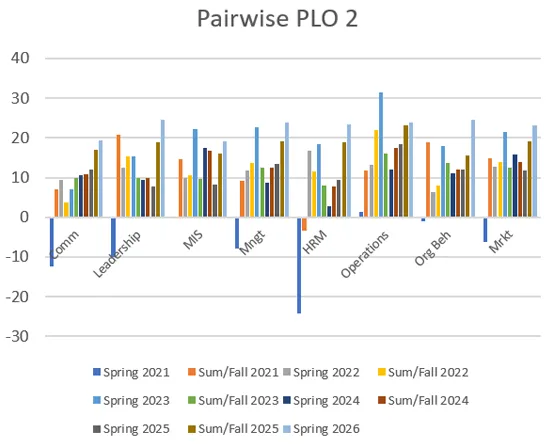
Image Transcript
MBA PLO 2: Pairwise Improvement by Subject Area
Description: Clustered column chart displaying pairwise comparison point growth between entry (MBA 5010) and capstone completion (MBA 5910) across eight academic subjects (Comm, Leadership, MIS, Mngt, HRM, Operations, Org Beh, Mrkt) over 11 measurement periods from Spring 2021 through Spring 2026. The Y-axis represents numerical point changes ranging from -30 to 40.
Data Breakdown
- Communications: Increased from -12.5 points in Spring 2021 to +19.3 points in Spring 2026.
- Leadership: Increased from -6.0 points in Spring 2021 to +24.5 points in Spring 2026.
- MIS: Increased from -1.0 point in Spring 2021 to +19.2 points in Spring 2026.
- Management: Increased from -9.0 points in Spring 2021 to +23.8 points in Spring 2026.
- HRM: Increased from -24.0 points in Spring 2021 to +23.5 points in Spring 2026.
- Operations: Increased from +1.5 points in Spring 2021 to +23.9 points in Spring 2026.
- Organizational Behavior: Increased from -1.0 point in Spring 2021 to +24.4 points in Spring 2026.
- Marketing: Increased from -8.0 points in Spring 2021 to +23.2 points in Spring 2026.
Program Learning Objective 3 (PLO 3)
Objective: Students can determine the potential financial impact of a given value creating activity.
| Performance Measure | 80% Benchmark | Score Trend | Pairwise Improvement |
|---|---|---|---|
| Instrument/Process | Analysis of written response to case analysis in the MBA 5910 capstone course — Summative, Direct, Internal. | Review and analysis of Peregrine results — Summative, Direct, External, Comparison. | Review and analysis of Peregrine results — Summative, Direct, External, Comparison. |
| Current Results | With the exception of Summer 2022, scores have consistently exceeded the benchmark. In Spring 2026, 96.2% of students (n=106) achieved High or Medium High. | There was a drop in Spring 2024 but the results have since recovered strongly. In Spring 2026, the Business Finance subject score reached 78.1 (n=161), a significant improvement from the 70.0 recorded in Summer/Fall 2025. | The pairwise results show consistently improved performance over the course of the program. In Spring 2026, the pairwise improvement in Business Finance was +27.8 percentage points (n=152), the strongest improvement recorded to date. |
| Analysis of Results | The results were satisfactory. | The results over the past academic year have been satisfactory | These results are positive but the decrease in improvement appears to be permanent. |
| Action Taken or Improvement Made | No change was required. | No change was required. | No action is required. |
Insert Graphs or Tables of Resulting Trends
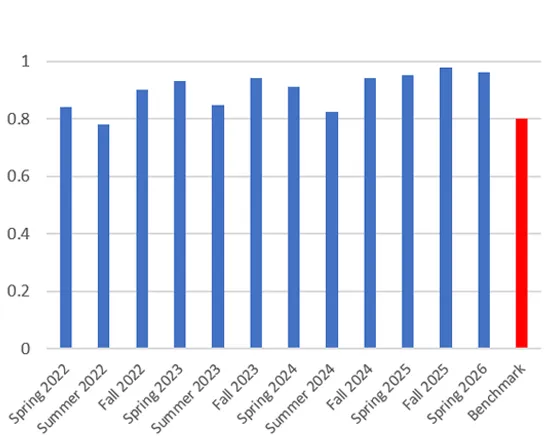
Image Transcript
MBA PLO 3: Financial Impact of Value-Creating Activities
Description: Bar chart tracking student achievement rates (proportion scoring High or Medium High) on written case analysis in MBA 5910 (blue bars) against the 0.80 (80%) benchmark (red bar) across 12 terms.
Data by Semester & Sample Size (n)
- Spring 2022: 0.842 (84.2%) | n = 19
- Summer 2022: 0.781 (78.1%) | n = 64
- Fall 2022: 0.902 (90.2%) | n = 41
- Spring 2023: 0.931 (93.1%) | n = 72
- Summer 2023: 0.848 (84.8%) | n = 33
- Fall 2023: 0.942 (94.2%) | n = 103
- Spring 2024: 0.913 (91.3%) | n = 103
- Summer 2024: 0.825 (82.5%) | n = 40
- Fall 2024: 0.941 (94.1%) | n = 102
- Spring 2025: 0.951 (95.1%) | n = 81
- Fall 2025: 0.980 (98.0%) | n = 101
- Spring 2026: 0.962 (96.2%) | n = 106
Summary: With the sole exception of Summer 2022 (78.1%), scores consistently exceeded the 80% benchmark across all terms. In Spring 2026, 96.2% of students (n=106) achieved High or Medium High, confirming satisfactory learning outcomes.
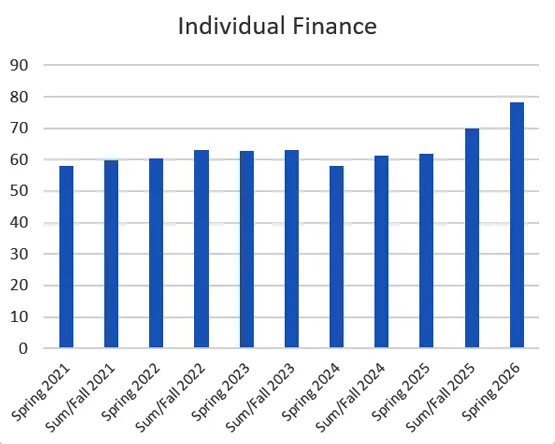
Image Transcript
MBA PLO 3: Individual Business Finance Peregrine Performance
Description: Bar chart tracking individual student performance in the Business Finance Peregrine subject area across 11 measurement periods from Spring 2021 through Spring 2026. The Y-axis scales from 0 to 90.
Data by Semester and Sample Size (n)
- Spring 2021: 58.0 | n = 15
- Summer/Fall 2021: 60.0 | n = 111
- Spring 2022: 60.5 | n = 109
- Summer/Fall 2022: 63.0 | n = 166
- Spring 2023: 62.8 | n = 108
- Summer/Fall 2023: 63.0 | n = 147
- Spring 2024: 58.0 | n = 112
- Summer/Fall 2024: 61.2 | n = 162
- Spring 2025: 62.0 | n = 119
- Summer/Fall 2025: 70.0 | n = 190
- Spring 2026: 78.1 | n = 161
Summary: Following a drop in Spring 2024 (58.0), scores recovered strongly, rising from 70.0 in Summer/Fall 2025 to a program high of 78.1 (n=161) in Spring 2026.
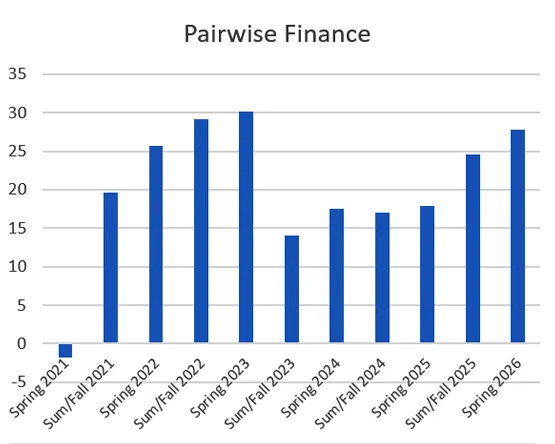
Image Transcript
MBA PLO 3: Pairwise Business Finance Score Improvement
Description: Bar chart displaying net pairwise percentage point changes in Business Finance between entry (MBA 5010) and capstone completion (MBA 5910) across 11 evaluation periods from Spring 2021 through Spring 2026.
Data by Semester and Sample Size (n)
- Spring 2021: -1.8 points | n = 22
- Summer/Fall 2021: +19.6 points | n = 132
- Spring 2022: +25.7 points | n = 136
- Summer/Fall 2022: +29.2 points | n = 212
- Spring 2023: +30.2 points | n = 120
- Summer/Fall 2023: +14.0 points | n = 174
- Spring 2024: +17.5 points | n = 103
- Summer/Fall 2024: +17.0 points | n = 154
- Spring 2025: +17.9 points | n = 112
- Summer/Fall 2025: +24.6 points | n = 181
- Spring 2026: +27.8 points | n = 152
Summary: Pairwise results show consistently improved performance throughout the MBA program, culminating in a +27.8 percentage point gain (n=152) in Spring 2026, the strongest recorded improvement to date since Spring 2023.
Program Learning Objective 4 (PLO 4)
Objective: Students can evaluate the potential ESG impact of a given value creating activity.
| Performance Measure | 80% Benchmark | Score Trend | Pairwise Improvement |
|---|---|---|---|
| Instrument/Process | Analysis of written response to case analysis in the MBA 5910 capstone course — Summative, Direct, Internal. | Review and analysis of Peregrine results — Summative, Direct, External, Comparison. | Review and analysis of Peregrine results — Summative, Direct, External, Comparison. |
| Current Results | With the exception of Fall 2022, scores have consistently exceeded the benchmark. In Spring 2026, 90.6% of students (n=106) achieved High or Medium High. | The results took a sharp decline in Spring 2024 but have since fully recovered. In Spring 2026, the Business Ethics subject score reached 80.5 (n=161), a significant improvement from the 72.0 recorded in Summer/Fall 2025. | After a dip to a low of +6.3 percentage points in Spring 2024, pairwise improvement in Business Ethics has recovered strongly. In Spring 2026, the pairwise improvement was +22.9 percentage points (n=152), the strongest positive improvement recorded to date. |
| Analysis of Results | The results were satisfactory. | The results were satisfactory. | The recovery in pairwise improvement is encouraging. |
| Action Taken or Improvement Made | No change was required. | No change was required. | No action is required. |
Insert Graphs or Tables of Resulting Trends
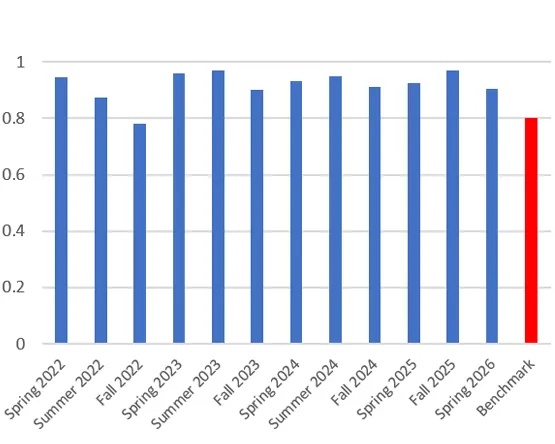
Image Transcript
MBA PLO 4: Evaluation of Potential ESG Impact
Description: Bar chart tracking student achievement rates (proportion scoring High or Medium High) on written case analysis in MBA 5910 (blue bars) against the 0.80 (80%) benchmark (red bar) across 12 terms.
Data by Semester & Sample Size (n)
- Spring 2022: 0.947 (94.7%) | n = 19
- Summer 2022: 0.875 (87.5%) | n = 64
- Fall 2022: 0.780 (78.0%) | n = 41
- Spring 2023: 0.958 (95.8%) | n = 72
- Summer 2023: 0.970 (97.0%) | n = 33
- Fall 2023: 0.903 (90.3%) | n = 103
- Spring 2024: 0.932 (93.2%) | n = 103
- Summer 2024: 0.950 (95.0%) | n = 40
- Fall 2024: 0.912 (91.2%) | n = 102
- Spring 2025: 0.926 (92.6%) | n = 81
- Fall 2025: 0.970 (97.0%) | n = 101
- Spring 2026: 0.906 (90.6%) | n = 106
Summary: With the sole exception of Fall 2022 (78.0%), scores consistently exceeded the 80% benchmark. In Spring 2026, 90.6% of students (n=106) achieved High or Medium High, confirming satisfactory learning results.
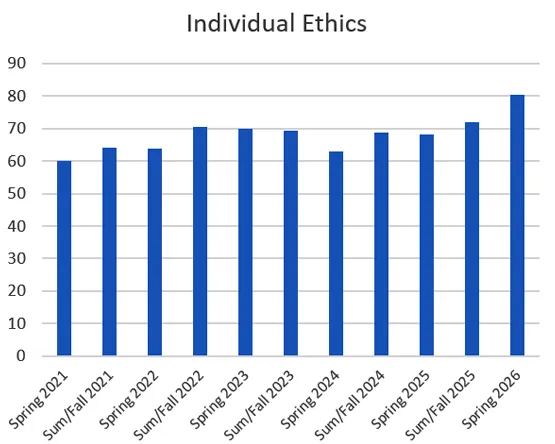
Image Transcript
MBA PLO 4: Individual Business Ethics Peregrine Performance
Description: Bar chart tracking individual student performance in the Business Ethics Peregrine subject area across 11 measurement periods from Spring 2021 through Spring 2026. The Y-axis scales from 0 to 90.
Data by Semester and Sample Size (n)
- Spring 2021: 60.0 | n = 15
- Summer/Fall 2021: 64.0 | n = 111
- Spring 2022: 63.8 | n = 109
- Summer/Fall 2022: 70.5 | n = 166
- Spring 2023: 70.0 | n = 108
- Summer/Fall 2023: 69.2 | n = 147
- Spring 2024: 63.0 | n = 112
- Summer/Fall 2024: 68.8 | n = 162
- Spring 2025: 68.1 | n = 119
- Summer/Fall 2025: 72.0 | n = 190
- Spring 2026: 80.5 | n = 161
Summary: Following a sharp decline in Spring 2024 (63.0), scores fully recovered, rising significantly from 72.0 in Sum/Fall 2025 to 80.5 (n=161) in Spring 2026.
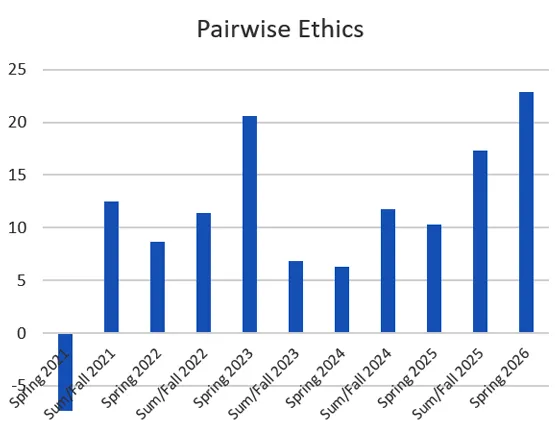
Image Transcript
MBA PLO 4: Pairwise Business Ethics Score Improvement
Description: Bar chart displaying net pairwise percentage point changes in Business Ethics between entry (MBA 5010) and capstone completion (MBA 5910) across 11 evaluation periods from Spring 2021 through Spring 2026.
Data by Semester and Sample Size (n)
- Spring 2021: -8.1 points | n = 22
- Summer/Fall 2021: +12.5 points | n = 132
- Spring 2022: +8.6 points | n = 136
- Summer/Fall 2022: +11.4 points | n = 212
- Spring 2023: +20.6 points | n = 120
- Summer/Fall 2023: +6.8 points | n = 174
- Spring 2024: +6.3 points | n = 103
- Summer/Fall 2024: +11.8 points | n = 154
- Spring 2025: +10.3 points | n = 112
- Summer/Fall 2025: +17.3 points | n = 181
- Spring 2026: +22.9 points | n = 152
Summary: After dipping to a low of +6.3 percentage points in Spring 2024, pairwise improvement recovered strongly to reach +22.9 points (n=152) in Spring 2026, the highest positive improvement recorded to date.
Comparison Data
| Performance Measure | Outbound Peregrine scores relative to ACBSP schools |
|---|---|
| Instrument/Process | Peregrine Assessment (Outbound Module), Direct, Summative, External, Comparative data |
| Current Results | With the exception of the first measurement period, Webster's MBA program has performed well against ACBSP benchmark data. In Spring 2026, Webster's overall outbound score of 80.7 exceeded the ACBSP benchmark of 65.7. |
| Insert Graphs or Tables of Resulting Trends |
Image TranscriptWebster MBA Assessment: Comparative Performance vs. ACBSP BenchmarkDescription: Bar chart comparing Webster's overall outbound Peregrine exam scores (blue bars) across 11 terms against the aggregate ACBSP benchmark of 65.7 (red bar). Data by Semester & Sample Size (n)
Summary: With the exception of the initial measurement term (Spring 2021, n=23), Webster's MBA program has performed consistently well against ACBSP benchmark data. In Spring 2026, Webster's overall outbound score reached 80.7 (n=158), significantly exceeding the ACBSP benchmark of 65.7. |
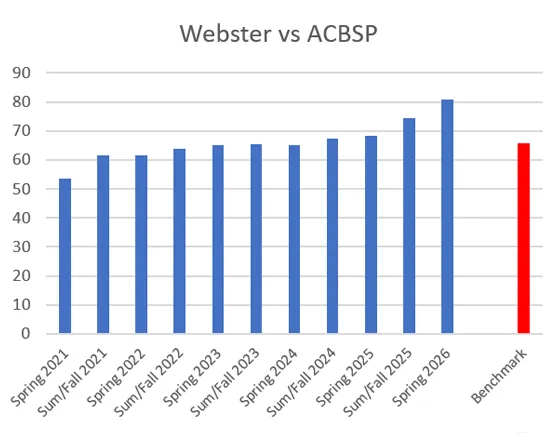
Comparison of Modality
| Performance Measure | Outbound Peregrine scores in online versus traditional formats |
|---|---|
| Instrument/Process | Peregrine Assessment (Outbound Module), Direct, Summative, External, Comparative data |
| Current Results | It appears that the two methods deliver approximately equivalent outcomes. In Spring 2026, ground students scored 82.5 (n=93) and online students scored 76.1 (n=68), a gap of 6.4 points. The ground advantage is slightly larger than in prior terms and will be monitored. |
| Action Taken or Improvement Made | The gap between the modalities that appeared in the spring will be monitored. |
| Insert Graphs or Tables of Resulting Trends |
Image TranscriptMBA Program Assessment: Outbound Performance Comparison by ModalityDescription: Clustered column chart comparing average outbound Peregrine exam scores between Ground (blue bars) and Online (orange bars) instructional modalities across 11 measurement terms from Spring 2021 through Spring 2026. The Y-axis scales from 0 to 90. Data by Semester & Sample Size (n)
Summary: The two instructional modalities deliver approximately equivalent learning outcomes across historical terms. In Spring 2026, Ground students achieved 82.5 (n=93) while Online students achieved 76.1 (n=68). The resulting 6.4-point Ground advantage is slightly larger than in prior terms and will continue to be monitored. |
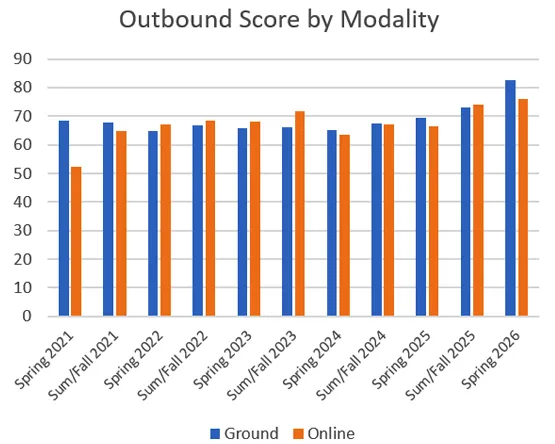
For all Program Learning Objectives, the following performance measure was used:
- 60% Benchmark: 80% of students will earn an overall score of 60% or higher.
Program Learning Objective 1 (PLO 1)
Objective: Students will be able use different analytics techniques and technologies to analyze complex datasets and solve real-world problems.
| Performance Measure | 60% Benchmark |
|---|---|
| Instrument/Process | Peregrine Assessment (Outbound Module), Direct, Summative, External, Comparative data |
| Current Results | A goal of 80% was set as a benchmark. 89.7% of the students scored an overall score 60% of higher. |
| Analysis of Results | Outbound data reveals a highly positive trajectory. Data and results suggest that course contents are aligned with SLO this year. |
| Action Taken or Improvement Made | No action. |
| Insert Graphs or Tables of Resulting Trends |
Image TranscriptMBA Analytics Learning Outcome 1: Score vs GoalDescription: Line graph tracking student performance percentage for Student Learning Outcome 1 (applying analytics techniques/technologies to complex datasets) against a fixed 80% benchmark target across three terms. Data
Summary: Performance on SLO 1 followed a strong upward trajectory, rising from 66.70% in Spring 2025 to surpass the 80% benchmark target in Fall 2025 (83.30%) and peaking at 89.70% in Spring 2026. |
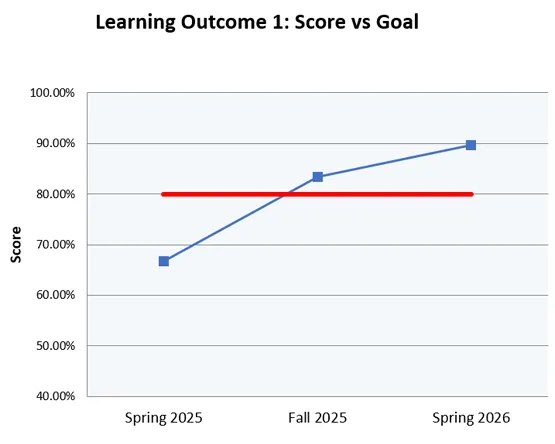
Program Learning Objective 2 (PLO 2)
Objective: Students will be able to apply analytical reasoning to inform organizational strategy and evidence-based decision-making.
| Performance Measure | 60% Benchmark |
|---|---|
| Instrument/Process | Peregrine Assessment (Outbound Module), Direct, Summative, External, Comparative data |
| Current Results | A goal of 80% was set as a benchmark. 93.1% of the students scored an overall score 60% of higher. |
| Analysis of Results | Outbound data reveals a highly positive trajectory. Data and results suggest that course contents are aligned with SLO this year. |
| Action Taken or Improvement Made | No action. |
| Insert Graphs or Tables of Resulting Trends |
Image TranscriptMBA Analytics Learning Outcome 2: Score vs GoalDescription: Line graph measuring the percentage of students achieving target proficiency for Student Learning Outcome 2 (applying analytical reasoning to inform organizational strategy) against an 80% target benchmark. Data
Summary: Scores on SLO 2 demonstrated steady progress across three consecutive semesters, climbing from 66.70% in Spring 2025 to exceed the 80% goal in Spring 2026 at 93.10%. |
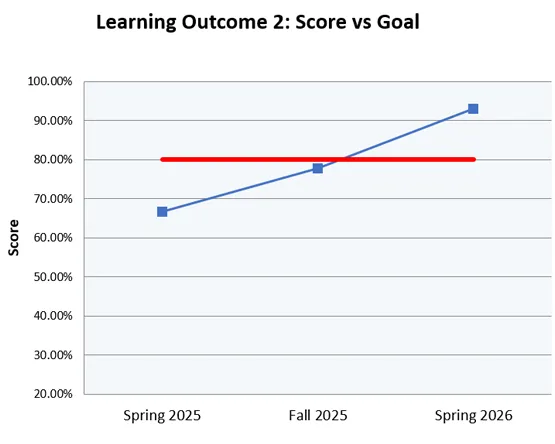
Program Learning Objective 1 (PLO 1)
Objective: Students can determine the value of financial assets.
For this Program Learning Objective, the following performance measure was used:
- Average Comparison: Students exceed average ACBSP score of Capital Budgeting Techniques.
| Performance Measure | Average Comparison |
|---|---|
| Instrument/Process | Peregrine Accounting and Finance Exam. Summative, Direct, External, Comparative. |
| Current Results | Scores consistently between 75 and 80%. Exceed benchmark each period. |
| Analysis of Results | Small sample makes results for small programs like this difficult to interpret. Students, however, perform well in all subcategories. |
| Action Taken or Improvement Made | Program was changed this year to have more focus on corporate finance specifically. We will monitor impact on student learning. |
| Insert Graphs or Tables of Resulting Trends |
Image TranscriptMBA Corporate Finance PLO1: Capital Budgeting Score vs. ACBSP AverageDescription: Line graph tracking Webster student performance in Capital Budgeting (orange line) against the ACBSP benchmark (57.8, blue line) across five evaluation years. Data
|
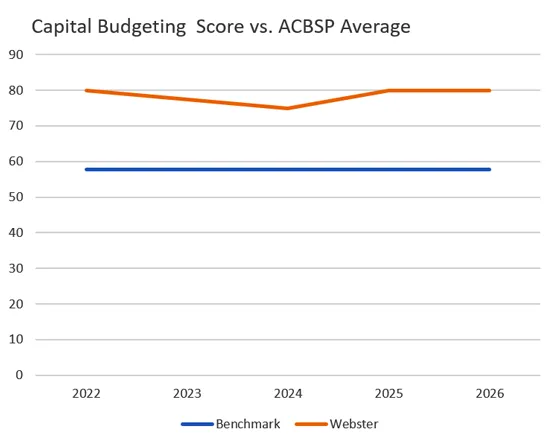
Program Learning Objective 2 (PLO 2)
Objective: Students can analyze the financial decisions of a corporation.
For this Program Learning Objective, the following performance measure was used:
- Average Comparison: Students exceed average ACBSP total score on the Peregrine Finance and Accounting exam. Students scores increase while in the program.
| Performance Measure | Average Comparison |
|---|---|
| Instrument/Process | Peregrine Accounting and Finance Exam. Average scores are used in comparison with ACBSP. Matched Sample data is used to look at differences between formative and summative results. Formative, Summative, Direct, External, Comparative. |
| Current Results | Scores, with the exception of 2022 have hovered around 80%, well above the ACBSP average. The average has increased from 69.8% in 2022 to 79.5% in 2026. The matched sample shows that outbound scores exceed inbound scores in each topic area. Total score improve by 13.4 percentage points during students degree program. |
| Analysis of Results | Students do well in all areas. However, the two lowest performing areas are TVM and Capital Structure with average scores of 66.3% and 72.5% and increases of only 6.3 and 3.7 percentage points. |
| Action Taken or Improvement Made | We will monitor to see if program changes impact scores, particularly in the area of capital budgeting. Increased focused on corporate decisions should improve learning in this area. |
| Insert Graphs or Tables of Resulting Trends |
Image TranscriptMBA Corporate Finance PLO2: Average Total Score on Finance ExamDescription: Line graph showing Webster overall score on the Peregrine Finance Exam (blue line) relative to the ACBSP benchmark (63.2, orange line) from 2022 through 2026. Data
Summary: With the exception of 2022 (69.8%), scores hovered around 80.0%, remaining well above the ACBSP average and showing an overall increase from 69.8% in 2022 to 79.5% in 2026.
Image TranscriptMBA Corporate Finance PLO2: Inbound vs. Outbound Results by TopicDescription: Clustered bar chart displaying matched sample performance growth from Inbound (blue bars) to Outbound (orange bars) across eleven corporate finance topic areas. Data by Topic Subcategory
Summary: Outbound scores exceeded inbound baselines across every topic, yielding an overall total score gain of 13.4 percentage points. Time Value of Money (TVM) and Capital Structure recorded the lowest outbound averages at 66.3% (+6.3 point gain) and 72.5% (+3.7 point gain), respectively. |
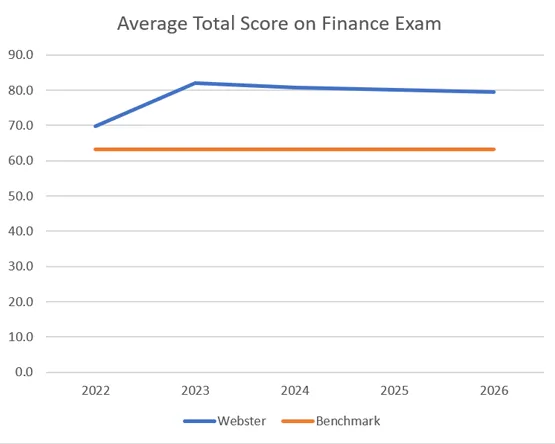
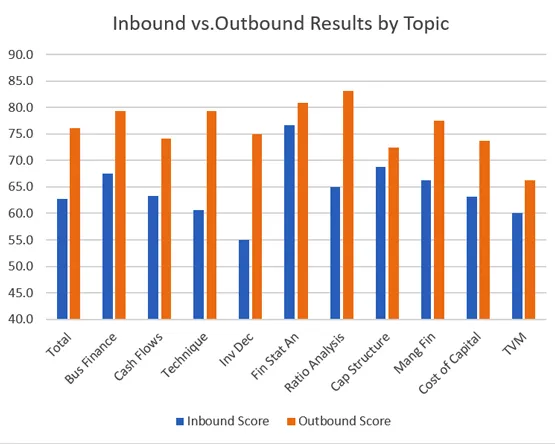
Program Learning Objective 1 (PLO 1)
Objective:
For this Program Learning Objective, the following performance measure was used:
- Component Comparison: For the study period, Cybersecurity emphasis students will score ten or more points higher on the Information Security component of the Peregrine exam than non Cybersecurity emphasis students.
| Performance Measure | Component Comparison |
|---|---|
| Instrument/Process | Peregrine Exam. Direct, Summative, External, Comparative. |
| Current Results | Cyber students scored an average of 100 versus an average of 73.2 for non-emphasis students. |
| Analysis of Results | The sample size is too small to be meaningful (n= 4 vs 583). But the tested Cyber students performed as expected. |
| Action Taken or Improvement Made | There is no discernible shortcoming in the curriculum. But we will need to determine an alternative method of assessment. |
| Insert Graphs or Tables of Resulting Trends |
Image TranscriptMBA Cybersecurity Emphasis Assessment: Information Security ComponentDescription: Bar chart comparing average scores on the Information Security component of the Peregrine Exam between Cyber Emphasis students and non-emphasis students, alongside the corresponding assessment report details. Data
|
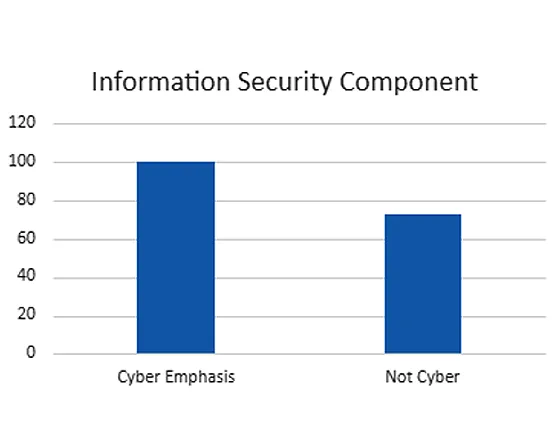
For all Program Learning Objectives, the following performance measure was used:
- 60% Benchmark: 80% of students will earn an overall score of 60% or higher.
Program Learning Objective 1 (PLO 1)
Objective: Students will be able to evaluate and select projects based on broader organizational goals.
| Performance Measure | 60% Benchmark |
|---|---|
| Instrument/Process | Peregrine Assessment (Outbound Module), Direct, Summative, External, Comparative data |
| Current Results | A goal of 80% was set as a benchmark. 84.6% of the students scored an overall score 60% of higher. |
| Analysis of Results | Outbound data reveals a highly positive trajectory. Data and results suggest that course contents are aligned with SLO this year. |
| Action Taken or Improvement Made | No action. |
| Insert Graphs or Tables of Resulting Trends |
Image TranscriptMBA Project Management Learning Outcome 1: Score vs GoalDescription: Line graph tracking student performance percentage for Learning Outcome 1 (evaluating and selecting projects based on broader organizational goals) against a fixed 80% target benchmark line across three academic years. Data
Summary: Performance on LO 1 followed a consistent upward trajectory, climbing from 50.00% in 2023-2024 to surpass the 80% target goal in 2025-2026 at 84.60%. |
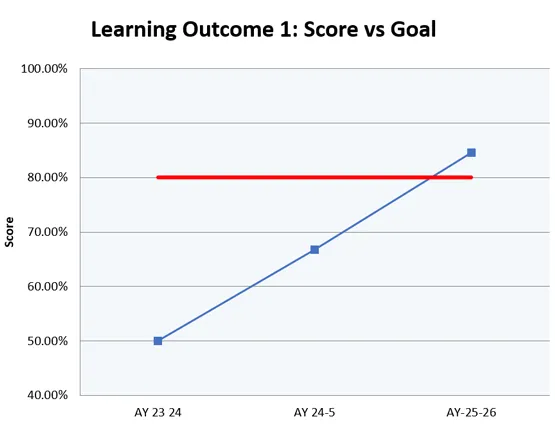
Program Learning Objective 2 (PLO 2)
Objective: Students will be able to guide, motivate and manage diverse, cross-functional project teams.
| Performance Measure | 60% Benchmark |
|---|---|
| Instrument/Process | Peregrine Assessment (Outbound Module), Direct, Summative, External, Comparative data |
| Current Results | A goal of 80% was set as a benchmark. 76.9% of the students scored an overall score 60% of higher. |
| Analysis of Results | Data and results suggest that the score falls slightly below our established target of 80%. The results were communicated with Assessment Team and Faculty. |
| Action Taken or Improvement Made | Communicated with Assessment Team and Faculty. Will monitor the performance metrics for one additional academic year prior to implementing structural curricular modifications. |
| Insert Graphs or Tables of Resulting Trends |
Image TranscriptMBA Project Management Learning Outcome 2: Score vs GoalDescription: Line graph measuring student performance percentage for Learning Outcome 2 (guiding, motivating, and managing diverse cross-functional project teams) against an 80% target benchmark across three academic years. Data
Summary: Scores on LO 2 fluctuated significantly, jumping from 25.00% in 2023-2024 to a peak of 100.00% in 2024-2025 before settling at 76.90% in 2025-2026, slightly below the 80% goal. |
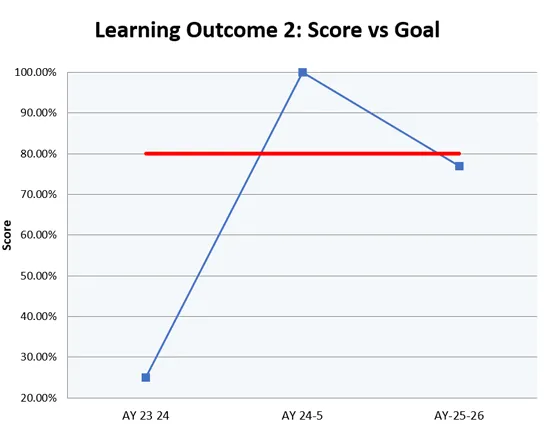
Program Learning Objective 3 (PLO 3)
Objective: Students will be able to synthesize complex metrics to make quantitative project adjustments.
| Performance Measure | 60% Benchmark |
|---|---|
| Instrument/Process | Peregrine Assessment (Outbound Module), Direct, Summative, External, Comparative data |
| Current Results | A goal of 80% was set as a benchmark. 84.6% of the students scored an overall score 60% of higher. |
| Analysis of Results | Outbound data reveals a highly positive trajectory. Data and results suggest that course contents are aligned with SLO this year. |
| Action Taken or Improvement Made | No action. |
| Insert Graphs or Tables of Resulting Trends |
Image TranscriptMBA Project Management Learning Outcome 3: Score vs GoalDescription: Line graph tracking student performance percentage for Learning Outcome 3 (synthesizing complex metrics to make quantitative project adjustments) against a fixed 80% target benchmark line across three academic years. Data
Summary: Scores on LO 3 demonstrated steady, positive growth over three academic years, rising from 50.00% in 2023-2024 to exceed the 80% target goal at 84.60% in 2025-2026. |
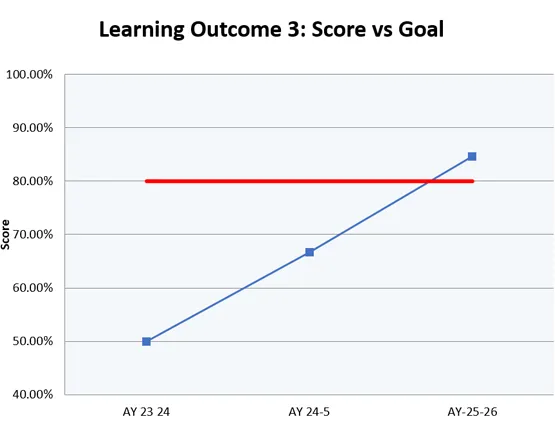
Program Learning Objective 1 (PLO 1)
Objective: Students will be able to explain healthcare leadership styles and demonstrate effective communication skills that are required in managing effective teams and in predicting human behavior in an organization.
For this Program Learning Objective, the following performance measure was used:
- Pairwise Improvement: The average score on the Webster Outbound Peregrine topics that are relevant to PLO-1 will be on par with the average scores from all MHA programs at other universities that use the Peregrine MHA Assessment.
| Performance Measure | Pairwise Improvement |
|---|---|
| Instrument/Process | We used inbound and outbound student scores on the five Peregrine topics that measure student ability in the five MHA competencies aligned with PLO-1: Community and the Environment, Communication Skills, Organizational Dynamics, Human Resources, and Leadership Skills and Behavior. This instrument is summative, external, direct and provides comparative data between inbound and outbound student scores. |
| Current Results | The current results for Learning Objective 1 showed the outbound scores to be 3.5% greater than the inbound scores. there are two factors to consider. First, given that due to the Peregrine change in test data banks in January 2022, we were limited to an N of 55 students who had taken both the inbound and outbound tests utilizing comparable testing materials. Second, the small sample size did not allow for year on year comparisons but rather an aggregate score. |
| Analysis of Results | Although we are encouraged by the positive percentage change from inbound to outbound scores, we will review our course material for applicable improvements in our student experience with the intent of growing the percentage change. |
| Action Taken or Improvement Made | Next step is to continue to evaluate sample size during upcoming analyses to assess statistical power for more in-depth analysis. We will also employ continuous improvement techniques for ongoing review of these subject areas. |
| Insert Graphs or Tables of Resulting Trends |
Image TranscriptMaster of Health Administration (MHA) Aggregate Scores PLO 1 (8/2022 - 6/2026, n=55)Description: A bar chart comparing aggregate Inbound and Outbound Peregrine MHA assessment scores for PLO 1 (Community and Environment, Communication Skills, Organizational Dynamics, Human Resources, and Leadership Skills and Behavior), alongside net point difference and percentage change. Data
|
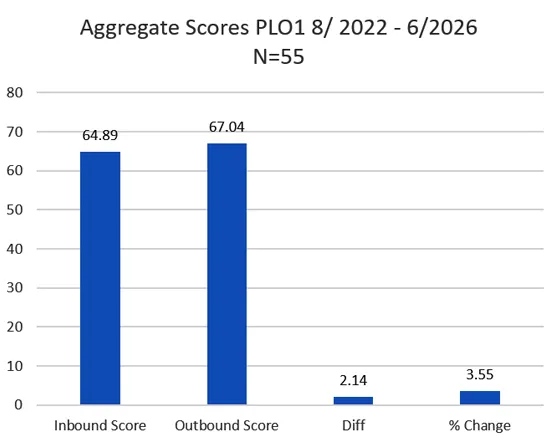
Program Learning Objective 2 (PLO 2)
Objective: Students will be able to apply fundamental healthcare management skills to problem-solving, decision-making, planning, delegation, communication and time management.
For this Program Learning Objective, the following performance measure was used:
- Pairwise Improvement: The average score on the Webster Outbound Peregrine topics that are relevant to PLO-2 will be will be better than the average score on the Peregrine Webster Inbound Assessment.
| Performance Measure | Pairwise Improvement |
|---|---|
| Instrument/Process | We used inbound and outbound student scores on the five Peregrine topics that measure student ability in the five MHA competencies aligned with PLO-2: Community and the Environment, Communication Skills, Organizational Dynamics, Human Resources, and Leadership Skills and Behavior. |
| Current Results | There has been a 4.9% improvement in Learning Objective 2 scores between 2022 and 2026. |
| Analysis of Results | We have learned that there is a positive learning curve for our students in aggregate with respect to Learning Objective 2. We will continue to refine and evaluate our course offerings in this area. |
| Action Taken or Improvement Made | As our sample size continues to increase with students having completed both the Inbound and Outbound tests using comparable testing strategies, we are hopeful that the upward differential will expand. We will continue to evaluate and improve the courses in this area. |
| Insert Graphs or Tables of Resulting Trends |
Image TranscriptMaster of Health Administration (MHA) Aggregate Scores PLO 2 (8/2022 - 6/2026, n=55)Description: A bar chart measuring student ability in MHA competencies aligned with PLO 2 across Inbound vs. Outbound assessments, displaying difference and percentage change. Data
|
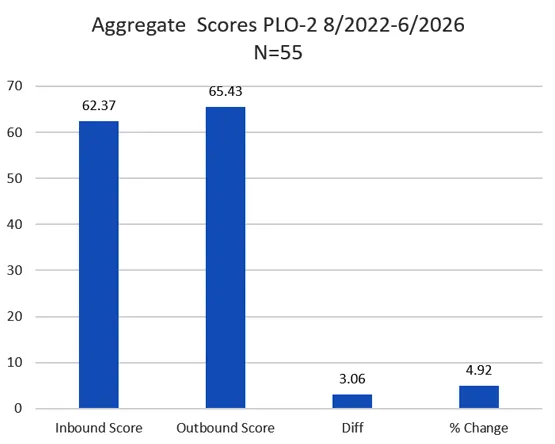
Program Learning Objective 3 (PLO 3)
Objective: Students will be able to incorporate strategic thinking to set priorities, focus energy and resources, strengthen operations, ensure that employees and other stakeholders are working towards common goals, and to operationalize healthcare organization’s mission and vision.
For this Program Learning Objective, the following performance measure was used:
- Pairwise Improvement: The average score on the Webster Outbound Peregrine topics that are relevant to PLO-3 will be better than the average score on the Peregrine Webster Inbound Assessment.
| Performance Measure | Pairwise Improvement |
|---|---|
| Instrument/Process | We use inbound and outbound student scores on the three Peregrine topics that measure student ability in the three MHA competencies aligned with PLO-3: Strategic Planning, Health Policy, and Quality and Process Improvement. This instrument is summative, external, direct and provides comparative data between inbound and outbound student scores. |
| Current Results | Our inbound outbound score percentage change is -3.4%. |
| Analysis of Results | Although this percentage change is notable with respect to our students' experience in relation to this learning objective, we are aware that these results could be influenced by the level of statistical power, particularly as last year our percentage change was 68% positive. This wide variation leads us to believe that lack of statistical power may be impacting scores in relation to this learning objective. We will continue to evaluate student competencies through coursework and upcoming Peregrine evaluations. |
| Action Taken or Improvement Made | We will continue to monitor the student inbound/outbound evaluations. As our sample size increases, we will be able to subset the data to evaluate the live virtual format in comparison to on-ground formats. We will also be able to compare year on year outgoing scores and the domestic student scores in comparison to the international student scores. This ongoing evaluation will allow us to continually improve our program offerings. |
| Insert Graphs or Tables of Resulting Trends |
Image TranscriptMaster of Health Administration (MHA) Aggregate Scores PLO 3 (8/2022 - 6/2026, n55)Description: A bar chart evaluating PLO 3 topics (Strategic Planning, Health Policy, Quality and Process Improvement) comparing Inbound and Outbound performance along with point difference and percentage change. Data
|
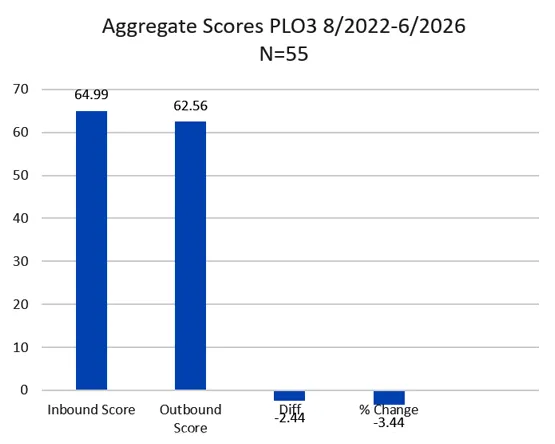
Summary
The following performance measure was used:
- Peregrine Benchmark: The average total score on the MHA Peregrine exam should equal or exceed that of the Peregrine Benchmark (All MHA results).
| Performance Measure | Peregrine Benchmark |
|---|---|
| Instrument/Process | Peregrine Exam: External, Comparative, Formative, Summative, Comparative |
| Current Results | Our results are very close to the benchmark. The most current year shows an outbound score of 66.1 vs. the benchmark of 65.7. As we have increased our international student population over the last two years we have experienced a large increase in inbound scores. |
| Analysis of Results | Our results appear to closely follow national averages. We will continue to evaluate student competencies through coursework and upcoming Peregrine evaluations. We will also observe whether the recent increase in inbound scores lead to a similar increase in outbound scores when these students complete the program. |
| Action Taken or Improvement Made | As stated above, as we obtain more data, we will evaluate evaluate the live virtual format in comparison to on-ground format and the domestic student scores in comparison to the international student scores. This ongoing evaluation will allow us to continually improve our program offerings. |
| Insert Graphs or Tables of Resulting Trends |
Image TranscriptMaster of Health Administration (MHA) Summary Assessment Score Trends (2022-2026)Description: A multi-line graph tracking four-year performance trends for Inbound (blue line) and Outbound (orange line) scores against national Peregrine Benchmarks for Inbound (gray line, 58.4) and Outbound (yellow line, 65.6). Data
|
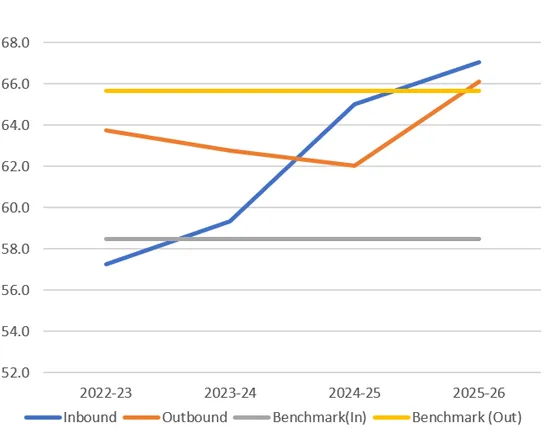
For all Program Learning Objectives, the following performance measure was used:
- 50% Benchmark: Students will score in upper 50 percentile compared to peer schools.
Program Learning Objective 1 (PLO 1)
Objective: Students will be able to evaluate the foundations of public administration globally.
| Performance Measure | 50% Benchmark |
|---|---|
| Instrument/Process | Peregrine Exam. Summative, External, Comparative. |
| Current Results | Results remain varied around upper 50 percentile with noticeable improvement in 2026. |
| Analysis of Results | Student learning remains consistent and demonstrates growth throughout the last three years of the program. |
| Action Taken or Improvement Made | Learning objectives and content delivery methodology is being evaluated. |
| Insert Graphs or Tables of Resulting Trends |
Image TranscriptPLO 1: Public Administration Principles and Foundations OutboundDescription: Line graph tracking student percentile rank performance in Public Administration Principles and Foundations on the Peregrine Exam across 2024, 2025 and 2026. Performance Data
Summary: Student learning demonstrates strong growth over the three-year period, rising steadily from 55% in 2024 to an optimal 87% in 2026. |
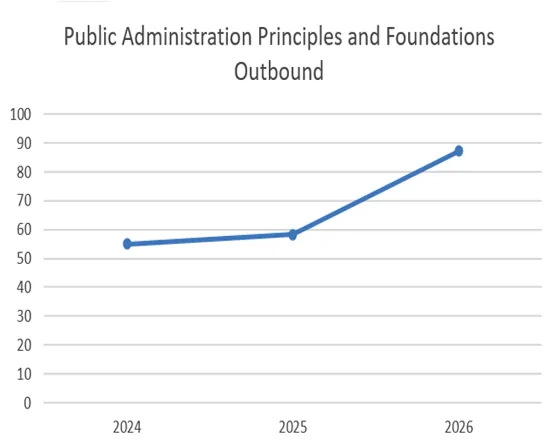
Program Learning Objective 2 (PLO 2)
Objective: Students will be able to compare the public sector to the nonprofit and private sectors.
| Performance Measure | 50% Benchmark |
|---|---|
| Instrument/Process | Peregrine Exam. Summative, External, Comparative. |
| Current Results | Consistent results for the prior two years followed by a noticeable increase in 2026. |
| Analysis of Results | Consistency of delivery and evaluation in the capstone course needs to be addressed. |
| Action Taken or Improvement Made | Learning objectives and content delivery methodology is being evaluated. Increased focused on consistency of evaluation is a priority. |
| Insert Graphs or Tables of Resulting Trends |
Image TranscriptPLO 2: Public vs NonprofitDescription: Line graph tracking student percentile rank performance comparing the public sector to nonprofit and private sectors on the Peregrine Exam across 2024, 2025 and 2026. Performance Data
Summary: Performance dipped slightly from 2024 to 2025 before rebounding sharply in 2026 to reach 87%. |
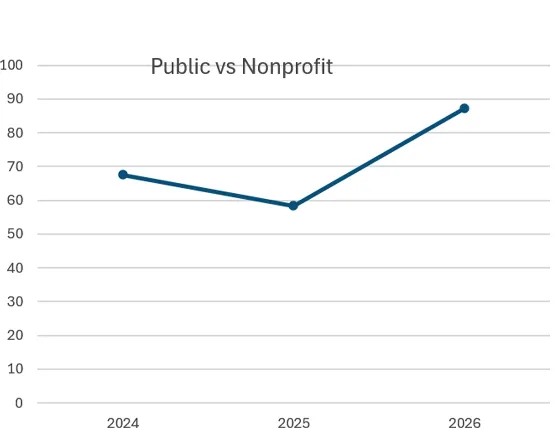
Program Learning Objective 3 (PLO 3)
Objective: Students will be able to integrate leadership and management practices to public service.
| Performance Measure | 50% Benchmark |
|---|---|
| Instrument/Process | Peregrine Exam. Summative, External, Comparative. |
| Current Results | Consistent improvement seen from years 2024 to 2026. |
| Analysis of Results | Student learning remains consistent and steady throughout the last three years of the program. |
| Action Taken or Improvement Made | Learning objectives and content delivery methodology is being evaluated. |
| Insert Graphs or Tables of Resulting Trends |
Image TranscriptPLO 3: Leadership in Public Administration OutboundDescription: Line graph tracking student percentile rank performance in leadership and management practices on the Peregrine Exam across 2024, 2025 and 2026. Performance Data
Summary: Student learning showed steady, positive growth over the three-year period, climbing consistently from 65% in 2024 to 93% in 2026. |
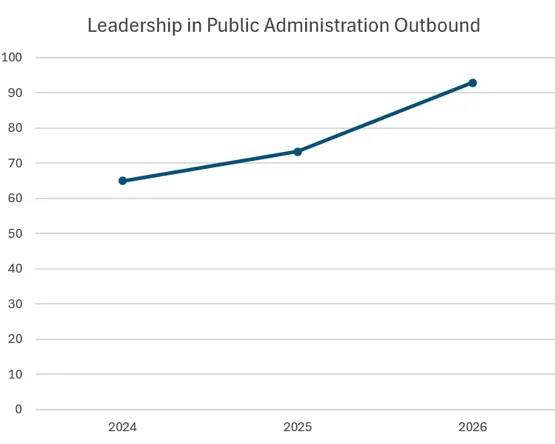
Program Learning Objective 4 (PLO 4)
Objective: Students will be able to analyze ethical and legal underpinnings of public governance.
| Performance Measure | 50% Benchmark |
|---|---|
| Instrument/Process | Peregrine Exam. Summative, External, Comparative. |
| Current Results | Consistent improvement in results observed from 2024 to 2026. |
| Analysis of Results | Consistency of delivery and evaluation in the capstone course needs to be addressed. |
| Action Taken or Improvement Made | Learning objectives and content delivery methodology is being evaluated. |
| Insert Graphs or Tables of Resulting Trends |
Image TranscriptPLO 4: Ethics and Social ResponsibilityDescription: Line graph tracking student percentile rank performance in analyzing ethical and legal underpinnings of public governance on the Peregrine Exam across 2024, 2025 and 2026. Performance Data
Summary: Assessment results reflect consistent improvement year-over-year, rising from 45% in 2024 to 86% in 2026. |
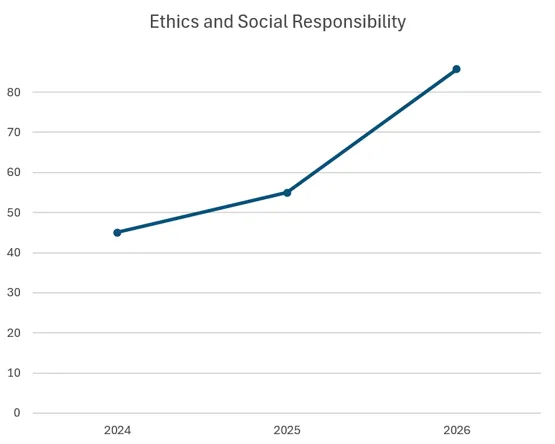
Program Learning Objective 5 (PLO 5)
Objective: Students will be able to assess transparency and accountability of public entities.
| Performance Measure | 50% Benchmark |
|---|---|
| Instrument/Process | Peregrine Exam. Summative, External, Comparative. |
| Current Results | Growth occurred between 2024 and 2025 with flat growth remaining in the upper percentiles. |
| Analysis of Results | Consistency of delivery and evaluation in the capstone course needs to be addressed. |
| Action Taken or Improvement Made | Learning objectives and content delivery methodology is being evaluated. |
| Insert Graphs or Tables of Resulting Trends |
Image TranscriptPLO 5: Transparency/AccountabilityDescription: Line graph tracking student percentile rank performance in assessing transparency and accountability of public entities on the Peregrine Exam across 2024, 2025 and 2026. Performance Data
Summary: Substantial growth occurred between 2024 and 2025 (55% to 73.5%), with scores holding flat in upper percentiles through 2026. |
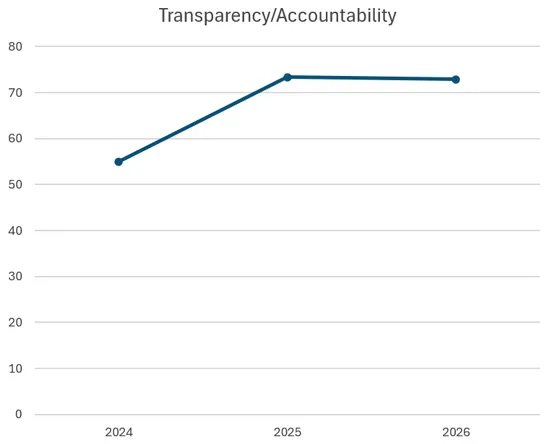
Program Learning Objective 6 (PLO 6)
Objective: Students will be debate sustainable, inclusive and civically engaged global societies.
| Performance Measure | 50% Benchmark |
|---|---|
| Instrument/Process | Peregrine Exam. Summative, External, Comparative. |
| Current Results | Consistent improvement for the from 2024 to 2026. |
| Analysis of Results | Consistency of delivery and evaluation in the capstone course needs to be addressed. |
| Action Taken or Improvement Made | Learning objectives and content delivery methodology is being evaluated. |
| Insert Graphs or Tables of Resulting Trends |
Image TranscriptPLO 6: SocietyDescription: Line graph tracking student percentile rank performance in debating sustainable, inclusive, and civically engaged global societies on the Peregrine Exam across 2024, 2025 and 2026. Performance Data
Summary: Performance improved consistently throughout the three-year period, rising from 37.5% in 2024 to well above 70% in 2026. |
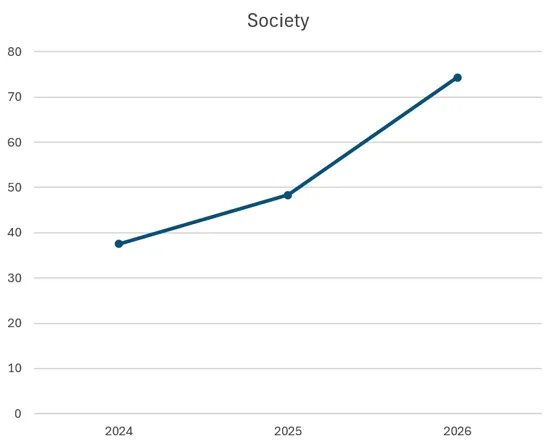
For all Program Learning Objectives, the following performance measure was used:
- Pairwise Improvement: To show an increase in outbound vs. inbound results and to have all learning outcomes average in the Medium (40%-70%) or High (70% and above) category on outbound exam.
Program Learning Objective 1 (PLO 1)
Objective: Students can determine the value of financial assets.
| Performance Measure | Pairwise Improvement |
|---|---|
| Instrument/Process | Peregrine Finance Exam. Categories: interest rates and bonds valuation, financial market environment and stock valuation. Direct, Formative, Summative, External, Comparative. |
| Current Results | Only one category (Market Environment) shows a result below 70% — 64.5% in 2023-2024. All other results exceed goal. |
| Analysis of Results | In general results are stable over the period reviewed. Small sample size can impact results. The decline in bond performance can be explained by one student scoring a 0% on this section of the exam. The matched sample shows that individual student performance increased during their time in the program. |
| Action Taken or Improvement Made | The MS in Finance was revised last academic year to place greater emphasis on corporate finance. We will monitor results. We expect it will lead to improved performance related to student learning outcomes. |
| Insert Graphs or Tables of Resulting Trends |
Image TranscriptLO1: Asset Valuation Pairwise Results By YearDescription: A clustered bar chart comparing inbound and outbound student performance for Learning Outcome 1 (Asset Valuation) across three academic years. Blue bars represent Inbound exam scores and orange bars represent Outbound exam scores. Data
Summary: Pairwise assessment data measured via the Peregrine Finance Exam shows consistent value-added growth for PLO 1 in each evaluated cycle, with outbound scores comfortably surpassing inbound baselines. Outbound performance remained strong across all three academic years, ranging between 78% and 83%. While incoming student baseline scores increased significantly from 2023-2024 (36.8%) to 2025-2026 (65.6%), outbound scores continued to demonstrate clear student progress throughout their time in the program.
Image TranscriptLO1: Average Score by CategoryDescription: A line graph displaying student performance across three academic years broken down by three sub-categories: Market Environment (blue line), Bonds (orange line), and Stock (gray line), compared against a 70.0% Benchmark (yellow horizontal line). Data
Summary: Across the three-year evaluation period, student performance across all three categories remained consistently above the 70.0% benchmark, with only Market Environment dipping below goal in 2023-2024 (64.5%) before rebounding strongly to 77% in subsequent years. Stock valuation demonstrated the highest stability, consistently hovering near 79%-82%. While Bonds peaked at 90.1% in 2024-2025 before dipping to 71.6% in 2025-2026 (partially impacted by small sample sizes and individual outlier scores), all sub-categories successfully met target benchmarks in the most recent cycle. |
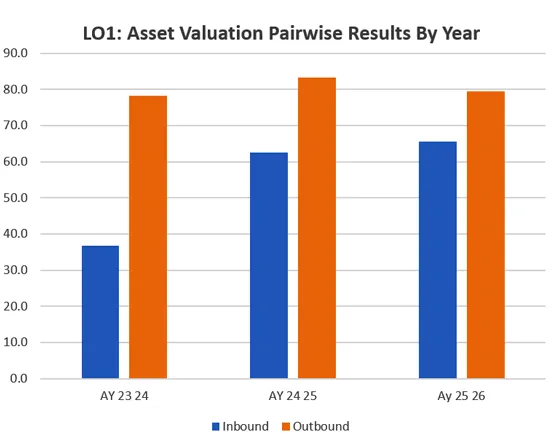
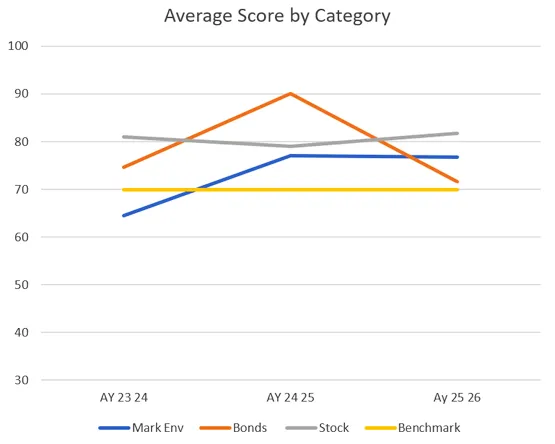
Program Learning Objective 2 (PLO 2)
Objective: Students can analyze the financial decisions of a corporation.
| Performance Measure | Pairwise Improvement |
|---|---|
| Instrument/Process | Peregrine Finance Exam. Categories: capital budgeting techniques, cost of capital, roles of managerial finance, financial statements and ratio analysis. Direct, Formative, Summative, External, Comparative. |
| Current Results | Averages exceed 70% with the exception of Capital Budgeting in 2023-2024 which shows an average of 64.5%. |
| Analysis of Results | Performance improved during students' program. All categories exceeded 70% over last two academic years. It appears that cost of capital and financial statements are the weaker areas. |
| Action Taken or Improvement Made | The MS in Finance was revised last academic year to place greater emphasis on corporate finance. We will monitor results. We expect it will lead to improved performance related to student learning outcomes. |
| Insert Graphs or Tables of Resulting Trends |
Image TranscriptLO2: Financial Decisions Pairwise Results By YearDescription: A clustered bar chart comparing incoming and outgoing student performance for Learning Outcome 2 (Financial Decisions) across three academic years. Blue bars represent "In" (Inbound) exam scores and orange bars represent "Out" (Outbound) exam scores. Data
Summary: Pairwise assessment data for Learning Outcome 2 demonstrates steady student learning growth and consistent performance across all three evaluated academic years. Outbound scores remained highly stable, achieving around 75% in each cycle (74.5% to 75.8%). Although inbound baseline scores experienced a slight downward trend over time from 60.5% in 2023-2024 to 55.0% in 2025-2026, the overall net gain widened, showing consistent value-added knowledge during students' time in the program.
Image TranscriptLO2: Average Score by CategoryDescription: A line graph displaying student performance across three academic years broken down by four sub-categories: Capital Budgeting (dark blue line), Cost of Capital (orange line), Roles of Finance (gray line), and Financial Statements (yellow line), compared against a 70.0% Benchmark (light blue horizontal line). Data
Summary: Student performance across all four categories met or exceeded the 70.0% benchmark goal by 2025-2026. While Capital Budgeting and Financial Statements started below the benchmark (64.6%) in 2023-2024, both saw substantial gains in subsequent years to comfortably pass target levels. Roles of Finance maintained strong performance throughout, rising to a peak of 80.0% in 2025-2026, while Cost of Capital experienced a slight decline over time but remained above the benchmark at 71.0%. |
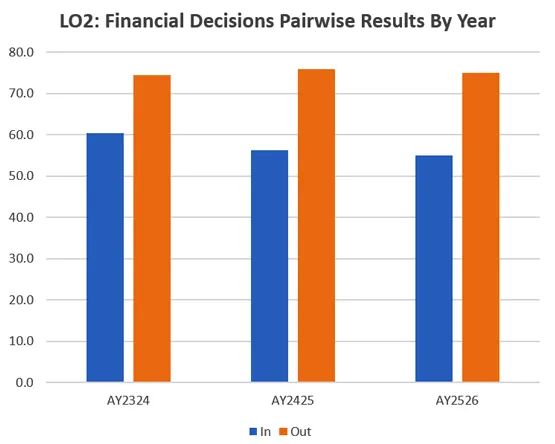
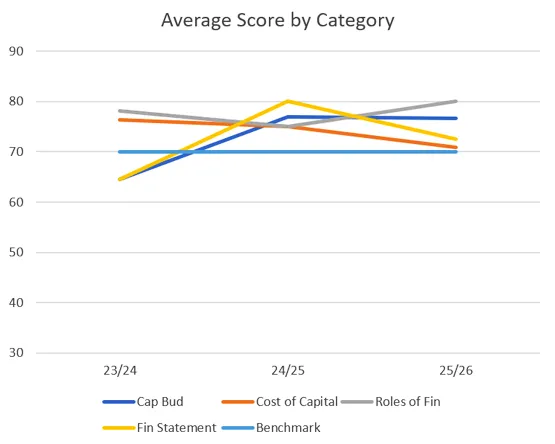
Program Learning Objective 3 (PLO 3)
Objective: Students can evaluate credit and interest rate risk.
| Performance Measure | Pairwise Improvement |
|---|---|
| Instrument/Process | Peregrine Finance Exam. Categories: risk and return. Direct, Formative, Summative, External, Comparative. |
| Current Results | Consistent with other outcomes, an average score above 70% plus improvement during the program was observed in all three years. |
| Analysis of Results | We have observed slight improvement over the last two years with scores exceeding 80% in both. |
| Action Taken or Improvement Made | The MS in Finance was revised last academic year to place greater emphasis on corporate finance. We will monitor results. We expect it will lead to improved performance related to student learning outcomes. |
| Insert Graphs or Tables of Resulting Trends |
Image TranscriptLO3: Risk and Return Pairwise Results and Average Score By YearDescription: A combination bar and line chart displaying student performance trends for MS Finance Program Learning Objective 3 across three academic years. Orange bars represent "In" (Inbound) assessment scores, gray bars represent "Out" (Outbound) assessment scores, and a blue trendline displays the Average score overall. Data
Summary: Pairwise assessment data for PLO 3 shows consistent academic growth from inbound baselines to outbound outcomes across all three evaluated cycles. Incoming baseline scores ("In") improved steadily year-over-year, climbing from 40.0% in 2023-2024 to 71.2% in 2025-2026. Outbound performance remained strong throughout, peaking at 83.3% in 2024-2025 and maintaining an 80.1% level in 2025-2026. Overall average student scores reflected this positive trend, holding at 80.0% or above in the most recent two academic years. |
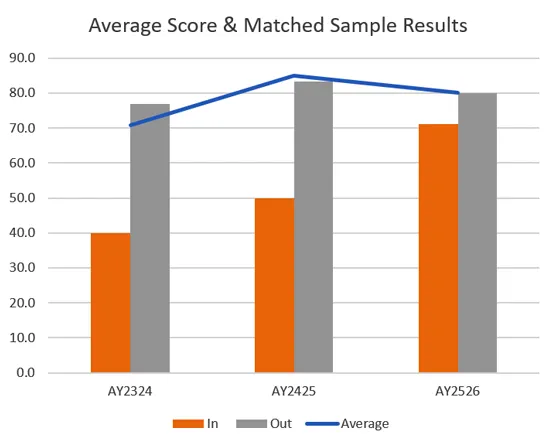
For all Program Learning Objectives, the following performance measure was used:
- 80% Benchmark: At least 80% of students will score 80% and above on direct assessment measures.
Program Learning Objective 1 (PLO 1)
Objective: Students will be able to explain the important terminology, facts, concepts, principles, analytic techniques and theories used in the field of information technology management.
| Performance Measure | 80% Benchmark |
|---|---|
| Instrument/Process | The students were assessed using a combination of assignments, multiple-choice and scenario-based questions, case study analyses which were basically direct assessment instruments. The benchmark reflects the program’s expectation which shows that the students have foundational knowledge. |
| Current Results | The assessment results showed that 85% of the students surpassed the benchmark, exceeding the program target of 80%. |
| Analysis of Results | The assessment results showed that the students have strong foundational knowledge in ITM concepts and theories. Although there is an opportunity for the students to further improve their analytical depth and integrative problem-solving capabilities. |
| Action Taken or Improvement Made | As a result of the assessment findings, the program will be introducing additional case-based learning activities, improving instruction on advanced analytical techniques and to refine assessment questions in order enhance conceptual depth. |
| Insert Graphs or Tables of Resulting Trends |
Image TranscriptMA Information Technology Management PLO 1Description: A combination bar and line chart displaying student performance trends across six measurement periods. Blue vertical bars represent the proportion of students meeting the learning goal, a horizontal orange line indicates the benchmark target (80%), and a black line tracks total assessed student enrollment over time. Data
|
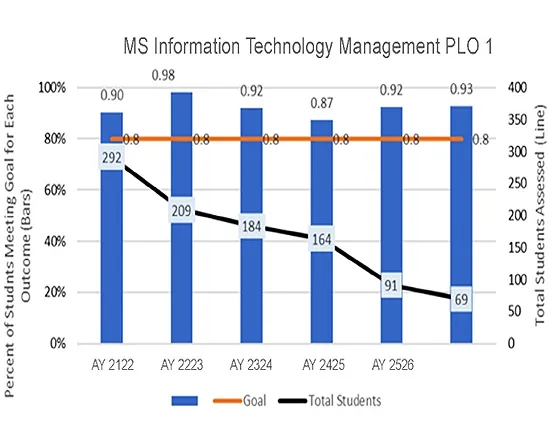
Program Learning Objective 2 (PLO 2)
Objective: Students will be able to effectively apply important terminology, facts, concepts, principles, analytic techniques and theories used in the field of information technology management when analyzing complex factual situations.
| Performance Measure | 80% Benchmark |
|---|---|
| Instrument/Process | The students were assessed using applied project reports, case study analyses, and capstone project evaluations using standardized rubrics. |
| Current Results | The current assessment results show that the students met or exceeded the benchmark, thereby surpassing the program target of 80%. |
| Analysis of Results | Results indicate that students demonstrate strong ability to apply IT management concepts to practical situations. However, some students need improvement in handling highly complex scenarios involving multiple organizational and technical factors. |
| Action Taken or Improvement Made | Based on the assessment findings, the program will introduce more complex case studies and simulations, increase assignment requiring cross-functional analysis, and the program will continue to monitor student performance to ensure continuous improvement. |
| Insert Graphs or Tables of Resulting Trends |
Image TranscriptMA Information Technology Management PLO 2Description: A combination bar and line chart displaying student performance trends across six measurement periods. Blue vertical bars represent the proportion of students meeting the learning goal, a horizontal orange line indicates the benchmark target (80%), and a black line tracks total assessed student enrollment over time. Data
|
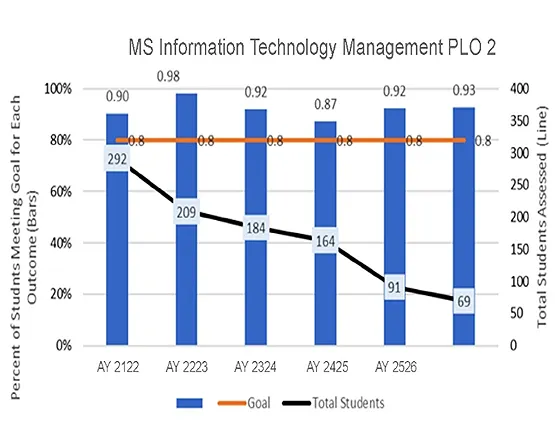
Program Learning Objective 3 (PLO 3)
Objective: Students will be able to effectively integrate (or synthesize) important facts, concepts, principles and theories in the field of information technology management when developing solutions to multifaceted information technology management problems in complex factual situations.
| Performance Measure | 80% Benchmark |
|---|---|
| Instrument/Process | The PLO was assessed using research-based assignments, capstone projects, complex case study analyses and faculty evaluation rubrics. This benchmark ensures that students demonstrate advanced competency in higher-order thinking, including integration, evaluation, strategic reasoning and solution design. |
| Current Results | The assessment results indicated that more than 80% of the students met or exceeded the benchmark, achieving the expected competency level of 80%. |
| Analysis of Results | The results indicate that the program effectively prepares students to synthesize knowledge from multiple areas of Information Technology Management and apply that knowledge to complex problem-solving situations. |
| Action Taken or Improvement Made | To improve performance, the program will improve collaborative problem-solving exercises, strengthen project-based learning activities, and increase multidisciplinary case studies and will continue to monitor performance to support continuous improvement in higher-level analytical and synthesis skills. |
| Insert Graphs or Tables of Resulting Trends |
Image TranscriptMA Information Technology Management PLO 3Description: A combination bar and line chart displaying student performance trends across six measurement periods. Blue vertical bars represent the proportion of students meeting the learning goal, a horizontal orange line indicates the benchmark target (80%), and a black line tracks total assessed student enrollment over time. Data
|
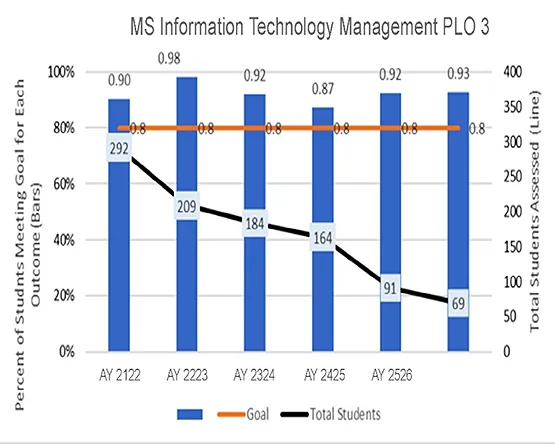
Program Learning Objective 4 (PLO 4)
Objective: Students will be able to effectively lead and work well with others in IT project teams while applying critical thinking and organized problem-solving strategies to analyze and resolve challenging information technology issues.
| Performance Measure | 80% Benchmark |
|---|---|
| Instrument/Process | PLO4 was assessed using group case studies, project presentations, capstone projects and faculty assessment using standardized rubrics. |
| Current Results | Assessment results indicate that the students met or exceeded the benchmark, surpassing the program target of 80%. |
| Analysis of Results | Results indicate that students demonstrate strong teamwork, leadership and problem-solving skills. However, some students need improvement in conflict resolution and decision-making in dynamic project situations. |
| Action Taken or Improvement Made | The program will increase team-based activities, enhance real world project simulations and continue to monitor performance in order to support continuous improvement. |
| Insert Graphs or Tables of Resulting Trends |
Image TranscriptMA Information Technology Management PLO 4Description: A combination bar and line chart displaying student performance trends across six measurement periods. Blue vertical bars represent the proportion of students meeting the learning goal, a horizontal orange line indicates the benchmark target (80%), and a black line tracks total assessed student enrollment over time. Data
|
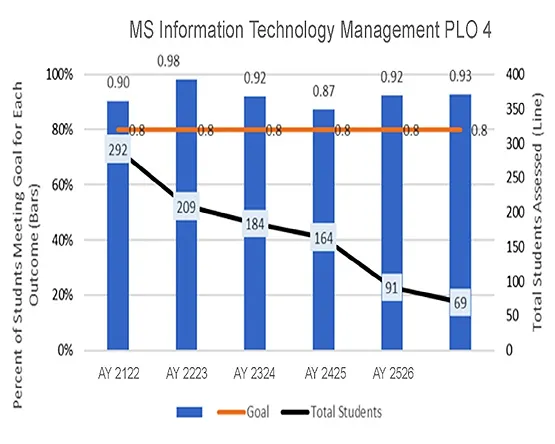
Program Learning Objective 1 (PLO 1)
Objective: Marketing Sensing — Students can identify activities that align organizational ability with market opportunities to create value for relevant stakeholders.
For this Program Learning Objective, the following performance measure was used:
- 70% Benchmark: 70% overall mean score and at least 70% of students scoring 70%. Overall mean score
should be on par with National mean score.
- Stretch goal: 75% overall mean score and at least 70% of students scoring 80%. Overall mean score significantly above the National mean score.
| Performance Measure | 70% Benchmark |
|---|---|
| Instrument/Process | Capsim ModExam — direct, formative, external, comparative. |
| Current Results |
The minimal goals were met:
The stretch goals were partially met:
|
| Analysis of Results |
The most notable development this cycle is distributional. For the first time, the program met its internal benchmark of at least 70% of students scoring above 70%: 75% of students cleared that bar, up from 67% in 2024-2025. The share scoring above 80% also rose sharply, from 0% to 75%. No student reached the 90% threshold. These gains are encouraging but must be weighed against the small cohort. At the item level, 14 of 26 concepts improved year over year, 11 held steady, and only one declined, a marked reversal from 2023-2024, when 13 concepts fell. Eight of 26 concepts remained below their national norm, fewer than in prior cycles, while the national norms themselves rose (overall national average of 68.63%, up from 65.47%), narrowing Webster's margin. Areas of Strength
Areas for Improvement These concepts stayed below national norms in both 2024-2025 and 2025-2026 and warrant continued attention:
The overall pattern is one of broad but fragile improvement: several previously flagged concepts recovered, the score distribution shifted upward, and only the Strategic Performance cluster shows a widening gap. Given the small sample, these results are best treated as directional rather than definitive. |
| Action Taken or Improvement Made |
Actions to Overcome Challenges
Actions to Leverage Current Success
|
| Insert Graphs or Tables of Resulting Trends |
Image TranscriptMRKT PLO1 Avg. ScoresDescription: A line graph tracking student performance for Program Learning Objective 1 across five academic cycles. The chart compares Post-test scores (black line with blue squares), Pre-test scores (light blue line with triangles), and the National Average (solid red line) against a Benchmark Goal of 70% (dashed red line with red Xs). Data
Summary: Post-test scores consistently exceed both the benchmark goal of 70 and the national average across all five measurement periods. Following a gradual decline from 2021-2022 through 2023-2024, post-test performance rebounded to 74.2 in 2024-2025. Notably, pre-test scores experienced a sharp rise in 2024-2025, narrowing the gap between pre- and post-test results. |
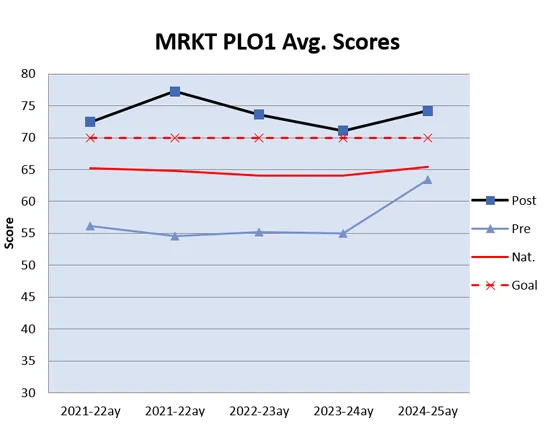
Program Learning Objective 2 (PLO 2)
Objective: Market Value Creation — Graduates will be able to effectively manage value creation by developing and evaluating marketing strategies and objectives to foster long-term success and promote meaningful relationships.
For this Program Learning Objective, the following performance measure was used:
- 55% Benchmark: Overall mean score should be on par with National mean score — 55% overall mean
score and at least 70% of students scoring 50%.
- Stretch goal: Overall mean score significantly above the National mean score — 60% overall mean score and at least 50% of students scoring 70%.
| Performance Measure | 55% Benchmark |
|---|---|
| Instrument/Process | Capsim ModExam — direct, formative, external, comparative. |
| Current Results |
The average post-test score for PLO 2 in 2025-2026 was 55.45%, down from 58.6% in 2024-2025 (a year-over-year decline of about 5.4%) and still below the program goal of 60%. For the first time in this reporting window the overall mean also fell below the national average (57.05%): Webster's score declined while national norms rose from 54.15% to 57.05%, flipping a prior margin of roughly +4.5 points to about -1.6 points. As in the prior cycle, the cohort is very small (n=3 as recorded), which limits generalizability and the reliability of year-over-year comparisons. The distribution softened at the top: 75% of students scored at least 50% (down from 100%), 50% scored at least 60% (up from 33%), and no student reached the 70% threshold for a second consecutive cycle. Item-level results point to a concentrated weakness in quantitative and statistical concepts, several of which registered 0% post-test performance. |
| Analysis of Results |
PLO 2 results declined in 2025-2026. The overall post-test mean fell to 55.45% from 58.6%, dropping below both the 60% program goal and, for the first time in this window, the national average (57.05%). The decline reflects both lower Webster performance and rising national norms. With only three students recorded, these figures should be read as directional rather than conclusive. At the item level the picture is mixed: 15 of 25 concepts met or exceeded their national norm, but the 10 that fell below cluster heavily in quantitative and statistical topics. Areas of Strength Several concepts reached 100% post-test performance, well above national norms:
Areas for Improvement The weaknesses concentrate in quantitative and analytical concepts, several scoring 0% this cycle:
The through-line is quantitative reasoning: statistics, regression, margins, and break-even analysis are the consistent soft spots, while conceptual and strategy items (channels, distribution, IMC, consumer behavior) are strengths. The drop below national this cycle, combined with the small sample, makes PLO 2 the clearest priority for both instructional attention and measurement review. |
| Action Taken or Improvement Made |
The Role of a Marketing Manager item remains below national, and it is hard to imagine graduates lacking a grasp of this role. We will continue to review the validity of this measure on the Capsim ModExam against how we define marketing-manager roles, and decide whether to have Capsim revise the item, remove it or revise our own definition. The clearer and more consequential pattern this cycle is weakness in quantitative and analytical concepts. Curriculum and Instructional Design
Enhanced Teaching Methods
Collaborative Learning and Peer Engagement
|
| Insert Graphs or Tables of Resulting Trends |
Image TranscriptMRKT PLO2 Avg. ScoresDescription: A line graph tracking student performance for Program Learning Objective 2 across five academic cycles. The chart compares Post-test scores (black line with blue squares), Pre-test scores (light blue line with triangles), and the National Average (solid red line with diamonds) against a Benchmark Goal of 60% (dashed red line). Data
Summary: Post-test performance shows an overall downward trend after exceeding the 60 benchmark goal in both 2021-2022 measurement periods. From 2022-2023 onward, post-test scores remained slightly below target, ultimately dipping to 55.5 in 2025-2026 and falling below the rising national average (57.1). Pre-test data collection showed notable improvement in 2024-2025 (50.0) before being omitted in 2025-2026. |
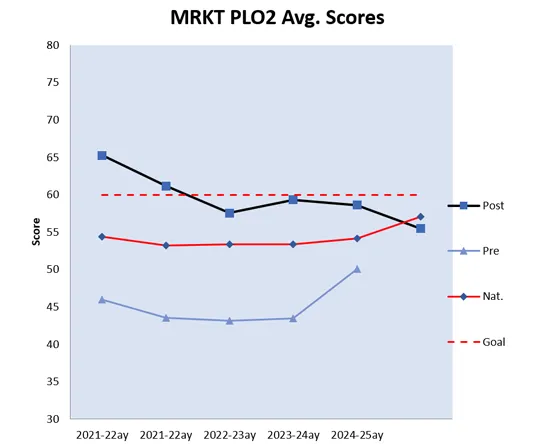
Program Learning Objective 3 (PLO 3)
Objective: Personal Management — Graduates will demonstrate personal skills (e.g. communication, personal brand management, ethics, team management) which are important keys to success as a marketing manager.
For this Program Learning Objective, the following performance measure was used:
- 65% Benchmark: Overall mean score should be on par with National mean score — 65% overall mean
score and at least 70% of students scoring 80%.
- Stretch goal: Overall mean score significantly above the National mean score — 75% overall mean score and at least 70% of students scoring 85%.
| Performance Measure | 65% Benchmark |
|---|---|
| Instrument/Process | Capsim ModExam — direct, formative, external, comparative. |
| Current Results |
PLO 3 post-test performance fell sharply in 2025-2026 to 45.71%, down from 70.83% in 2024-2025 (a year-over-year decline of about 35%). This is the first year in this window that the overall mean fell below the national average (69.55%) and, notably, below the cohort's own pre-test average (57.97%), indicating a negative overall learning gain: three of the four items scored lower on the post-test than the pre-test. The result also falls well short of the revised 65% minimal target that was set to be more attainable. The decline is broad. Three of the four items dropped year over year, and only Building Effective Goals held its performance. As in recent cycles the sample is very small (n=4), which limits generalizability, but a drop of this size across most items is a signal rather than noise. |
| Analysis of Results |
PLO 3 declined across the board in 2025-2026. The overall post-test mean fell to 45.71% from 70.83%, dropping below the 65% target, below the national average (69.55%), and below the cohort's own pre-test average, the first negative overall learning gain in this window. With four students the figures are directional, but the pattern is consistent across items. Developing Cross-Cultural Knowledge This remains the most serious and persistent concern, continuing a multi-year decline from 69.2% (2022-2023) to 55.6%, 37.5%, and now 25%, far below the national average (66.9%). Students also scored lower on the post-test than the pre-test. This points to a sustained problem in instruction, engagement, or assessment alignment and needs urgent attention. Preparing to Execute in a Team Setting This item fell again, from 37.5% to 25%, and sits well below national (62.7%), with a post-test below pre-test. Two weak cycles in a row make it the second priority for redesign of group-based learning. Cultural Competence Previously a strength, this item slipped in 2025-2026 from 75% to 62.5% and drew even with the national average (63.1%), with a post-test below pre-test. The prior upward trend did not hold, so the item now warrants monitoring rather than serving as a model. Building Effective Goals The lone strength. Post-test performance held at 95%, above the national average (85.5%), and it was the only item with a positive pre-to-post gain. The instructional approach here, structured goal-setting frameworks, is the clearest candidate to adapt for the weaker items. The through-line is that the cross-cultural and teamwork items collapsed while the goal-setting item held, pulling the outcome below national and below pre-test for the first time. Combined with the small sample, PLO 3 is the most concerning of the three outcomes this cycle and the strongest case for both instructional and measurement review. |
| Action Taken or Improvement Made |
|
| Insert Graphs or Tables of Resulting Trends |
Image TranscriptMRKT PLO3 Avg. ScoresDescription: A line graph tracking student performance for Program Learning Objective 2 across six academic cycles. The chart compares Post-test scores (black line with blue squares), Pre-test scores (light blue line with triangles), and the National Average (dotted red line with diamonds) against a Benchmark Goal (dashed red line) that shifts from 80 down to 65 in later periods. Data
Summary: Post-test scores began strong in 2021-2022 (84.5), exceeding the initial benchmark goal of 80. Performance then stabilized in the 70-74 range across subsequent cycles, staying above the national average and easily meeting the revised 65 benchmark goal in 2024-2025 (70.8). However, the final period saw a sharp drop in post-test scores down to 45.6, falling below the pre-test mean (58.0), the national average (69.5) and the benchmark goal line. |
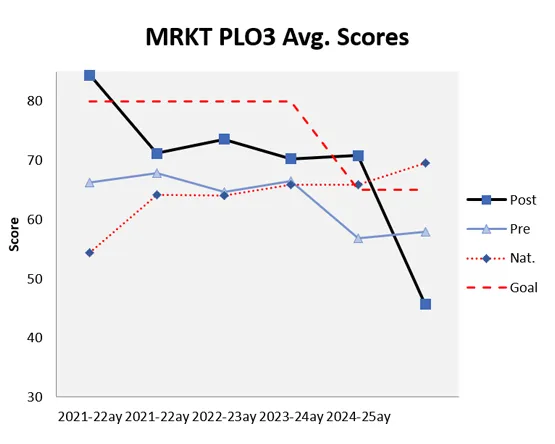
Operational Key Performance Indicators: Student Achievement
The Walker School of Business & Technology closely monitors operational key performance indicators (KPIs) to ensure our programs foster student persistence and timely degree completion. These metrics, managed in coordination with the Office of Institutional Effectiveness, serve as vital benchmarks for our continuous improvement efforts and institutional health.
In alignment with National Center for Educational Statistics (NCES) standards, the data below provides a transparent look at our retention and graduation trajectories.
Retention and Graduation Rates
Retention rates measure the percentage of students who continue their studies from one academic year to the next, while graduation rates track the successful completion of degree programs within established timeframes. These figures reflect our success in providing the academic support and resources necessary for students to reach their educational goals.
The following data tracks first-time, full-time (FTFT) degree-seeking freshmen cohorts.
| Cohort Year | FTFT Freshmen | 2nd Year # | 2nd Year Rate | 3rd Year # | 3rd Year Rate | 4th Year # | 4th Year Rate |
|---|---|---|---|---|---|---|---|
| 2000 | 412 | 326 | 79.1% | 284 | 68.9% | 256 | 62.1% |
| 2001 | 399 | 315 | 78.9% | 268 | 67.2% | 230 | 57.6% |
| 2002 | 387 | 304 | 78.6% | 267 | 69.0% | 229 | 59.2% |
| 2003 | 458 | 368 | 80.3% | 327 | 71.4% | 287 | 62.7% |
| 2004 | 448 | 361 | 80.6% | 324 | 72.3% | 303 | 67.6% |
| 2005 | 394 | 302 | 76.6% | 275 | 69.8% | 246 | 62.4% |
| 2006 | 413 | 334 | 80.9% | 302 | 73.1% | 281 | 68.0% |
| 2007 | 483 | 375 | 77.6% | 328 | 67.9% | 299 | 61.9% |
| 2008 | 407 | 325 | 79.9% | 288 | 70.8% | 264 | 64.9% |
| 2009 | 486 | 382 | 78.6% | 337 | 69.3% | 314 | 64.6% |
| 2010 | 413 | 332 | 80.4% | 288 | 69.7% | 254 | 61.5% |
| 2011 | 472 | 372 | 78.8% | 341 | 72.2% | 312 | 66.1% |
| 2012 | 411 | 332 | 80.8% | 290 | 70.6% | 262 | 63.7% |
| 2013 | 487 | 375 | 77.0% | 332 | 68.2% | 309 | 63.4% |
| 2014 | 457 | 357 | 78.1% | 302 | 66.1% | 273 | 59.7% |
| 2015 | 412 | 308 | 74.8% | 264 | 64.1% | 242 | 58.7% |
| 2016 | 433 | 343 | 79.2% | 290 | 67.0% | 266 | 61.4% |
| 2017 | 511 | 398 | 77.9% | 351 | 68.7% | 317 | 62.0% |
| 2018 | 479 | 377 | 78.7% | 339 | 70.8% | 308 | 64.3% |
| 2019 | 387 | 298 | 77.0% | 265 | 68.5% | - | - |
| 2020 | 390 | 301 | 77.2% | - | - | - | - |
| 2021 | 343 | - | - | - | - | - | - |
| Cohort Year | FTFT Freshmen | 4th Year # | 4th Year Rate | 5th Year # | 5th Year Rate | 6th Year # | 6th Year Rate |
|---|---|---|---|---|---|---|---|
| 2000 | 412 | 168 | 40.8% | 226 | 54.9% | 243 | 59.0% |
| 2001 | 399 | 179 | 44.9% | 228 | 57.1% | 242 | 60.7% |
| 2002 | 387 | 178 | 45.9% | 220 | 56.8% | 232 | 60.0% |
| 2003 | 458 | 214 | 46.7% | 285 | 32.2% | 296 | 64.6% |
| 2004 | 448 | 229 | 51.1% | 278 | 32.1% | 296 | 66.1% |
| 2005 | 394 | 175 | 44.4% | 226 | 57.4% | 239 | 60.7% |
| 2006 | 413 | 183 | 44.3% | 249 | 60.3% | 263 | 63.7% |
| 2007 | 483 | 203 | 42.0% | 265 | 54.9% | 286 | 59.2% |
| 2008 | 407 | 173 | 42.5% | 247 | 60.7% | 259 | 63.6% |
| 2009 | 486 | 208 | 42.8% | 276 | 56.8% | 302 | 62.1% |
| 2010 | 413 | 178 | 42.9% | 233 | 56.4% | 243 | 58.8% |
| 2011 | 472 | 225 | 47.7% | 284 | 60.2% | 300 | 63.6% |
| 2012 | 411 | 188 | 45.7% | 236 | 57.4% | 243 | 59.1% |
| 2013 | 487 | 186 | 38.2% | 261 | 53.6% | 282 | 57.9% |
| 2014 | 457 | 188 | 41.1% | 243 | 53.2% | 252 | 55.1% |
| 2015 | 412 | 184 | 44.7% | 224 | 54.4% | 235 | 57.0% |
| 2016 | 433 | 190 | 43.9% | 241 | 55.7% | - | - |
| 2017 | 511 | 252 | 49.3% | - | - | - | - |
| 2018 | 479 | - | - | - | - | - | - |
| 2019 | 387 | - | - | - | - | - | - |
| 2020 | 390 | - | - | - | - | - | - |
| 2021 | 343 | - | - | - | - | - | - |
The following data tracks new degree-seeking transfer cohorts.
| Cohort Year | New Transfers | 2nd Year # | 2nd Year Rate | 3rd Year # | 3rd Year Rate | 4th Year # | 4th Year Rate |
|---|---|---|---|---|---|---|---|
| 2009 | 349 | 249 | 71.3% | 144 | 41.3% | 68 | 19.5% |
| 2010 | 368 | 281 | 76.4% | 181 | 49.2% | 73 | 19.8% |
| 2011 | 339 | 270 | 79.6% | 161 | 47.5% | 45 | 13.3% |
| 2012 | 353 | 278 | 78.8% | 180 | 51.0% | 68 | 19.3% |
| 2013 | 319 | 262 | 82.1% | 161 | 50.5% | 50 | 15.7% |
| 2014 | 318 | 250 | 78.6% | 140 | 44.0% | 51 | 16.0% |
| 2015 | 319 | 246 | 77.1% | 138 | 43.3% | 46 | 14.4% |
| 2016 | 288 | 211 | 73.3% | 128 | 44.4% | 43 | 14.9% |
| 2017 | 233 | 177 | 76.0% | 110 | 47.2% | 27 | 11.6% |
| 2018 | 246 | 192 | 78.0% | 113 | 45.9% | 39 | 15.9% |
| 2019 | 222 | 157 | 70.7% | 85 | 38.3% | - | - |
| 2020 | 158 | 123 | 77.8% | - | - | - | - |
| 2021 | 176 | - | - | - | - | - | - |
| Cohort Year | New Transfers | 4th Year # | 4th Year Rate | 5th Year # | 5th Year Rate | 6th Year # | 6th Year Rate |
|---|---|---|---|---|---|---|---|
| 2009 | 349 | 202 | 57.9% | 219 | 62.8% | 223 | 63.9% |
| 2010 | 368 | 226 | 61.4% | 245 | 66.6% | 256 | 69.6% |
| 2011 | 339 | 216 | 63.7% | 227 | 67.0% | 233 | 68.7% |
| 2012 | 353 | 239 | 67.7% | 253 | 71.7% | 262 | 74.2% |
| 2013 | 319 | 209 | 65.5% | 219 | 68.7% | 227 | 71.2% |
| 2014 | 318 | 197 | 61.9% | 206 | 64.8% | 210 | 66.0% |
| 2015 | 319 | 201 | 63.0% | 210 | 65.8% | 215 | 67.4% |
| 2016 | 288 | 179 | 62.2% | 184 | 63.9% | - | - |
| 2017 | 233 | 153 | 65.7% | - | - | - | - |
| 2018 | 246 | - | - | - | - | - | - |
| 2019 | 222 | - | - | - | - | - | - |
| 2020 | 158 | - | - | - | - | - | - |
| 2021 | 176 | - | - | - | - | - | - |
The following data tracks degree-seeking graduate students across fall and spring cohorts.
| Cohort Session | Initial Headcount | Avg. Credits Earned After 1 Year | Avg. Terms Enrolled in 1 Year |
|---|---|---|---|
| FA16 | 2069 | 20.1 | 4.8 |
| SP17 | 1465 | 19.3 | 4.7 |
| FA17 | 1977 | 20.1 | 4.8 |
| SP18 | 1260 | 19.3 | 4.7 |
| FA18 | 1685 | 20.6 | 4.9 |
| SP19 | 1103 | 20.8 | 4.7 |
| FA19 | 1522 | 23.0 | 5.0 |
| SP20 | 962 | 22.1 | 4.8 |
| FA20 | 1174 | 20.7 | 4.9 |
| SP21 | 637 | - | - |
| Cohort Session | Initial Headcount | 1-Year Rate # | 1-Year Rate % | 2-Year Rate # | 2-Year Rate % | 3-Year Rate # | 3-Year Rate % | 4-Year Rate # | 4-Year Rate % | Avg. Time to Degree |
|---|---|---|---|---|---|---|---|---|---|---|
| FA16 | 2069 | 308 | 14.9% | 869 | 42.0% | 1240 | 60.0% | 1345 | 65.0% | 2.2 |
| SP17 | 1465 | 209 | 14.3% | 591 | 40.3% | 857 | 58.5% | 927 | 63.3% | 2.2 |
| FA17 | 1977 | 251 | 12.7% | 847 | 42.8% | 1191 | 60.2% | 1290 | 65.3% | 2.2 |
| SP18 | 1260 | 138 | 11.0% | 531 | 42.1% | 737 | 58.5% | - | - | 2.1 |
| FA18 | 1685 | 297 | 17.6% | 751 | 44.6% | 1022 | 60.7% | - | - | 1.9 |
| SP19 | 1103 | 146 | 13.2% | 526 | 47.7% | - | - | - | - | 1.7 |
| FA19 | 1522 | 314 | 20.6% | 684 | 44.9% | - | - | - | - | 1.4 |
| SP20 | 962 | 130 | 13.5% | - | - | - | - | - | - | 1.1 |
| FA20 | 1174 | 256 | 21.8% | - | - | - | - | - | - | 1.0 |
| SP21 | 637 | - | - | - | - | - | - | - | - | - |