

Finding His Voice: A Decade with Jerry Chang
May 21, 2026
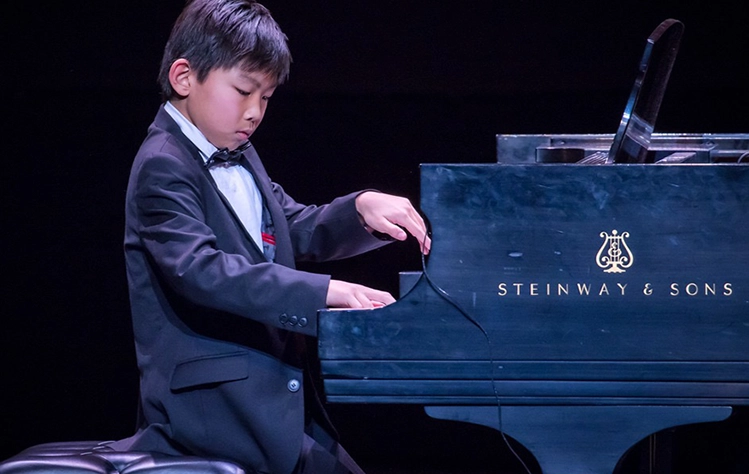
Jerry Chang came to Community Music School in second grade. He leaves at 18, Harvard-bound and carrying everything music has given him — which, it turns out, is quite a lot.
Jerry Chang has been a familiar presence at Community Music School for a decade now — from the beginning a prodigy with a robust history of competing and winning local, regional and national competitions. This spring, he's heading out the door for the last time as a student, and he's taking a lot with him.
Now a graduating senior at John Burroughs School, Jerry is heading to Harvard University this fall to study cognitive science and government. He's a 2024 YoungArts Winner with Distinction in Classical Music, a Regeneron International Science and Engineering Fair finalist, student body president, varsity tennis captain, researcher and podcast host — the bio is long and impressive. But sit with him for a few minutes and what comes through isn't the résumé. It's a genuine warmth, a habit of circling back to gratitude, and an unmistakable sense that music didn't just train his fingers — it shaped the person.
A Community He Grew Into
Jerry started at CMS when he was 8 years old, working with piano instructor Zena Ilyashov. He's been with her for more than 10 years — longer than most kids stay at anything.
"CMS has been like a perpetual resource and community for me," he says. "The support has just been constant throughout the years." He ticks off what that support has looked like in practice: recitals to prepare for, chamber music opportunities, access to accompanists and teachers, scholarship support and a reliable space to grow as a musician.
For a kid growing up in St. Louis, that last part matters more than it might sound. Jerry knows plenty of musicians from the coasts who grew up embedded in programs like Juilliard Pre-College, surrounded by other serious students and faculty at the highest levels. CMS, he says, filled that role here. "I don't think I would be — and a lot of people, not just me — I don't think a lot of people would be nearly as successful in their musical journeys without CMS."
He mentions previous CMS Director Carol Commerford and Vera Parkin, CMS faculty member and school accompanist by name — people who have shown up for him over the years. "I'm very indebted to that school."
What Zena Gave Him
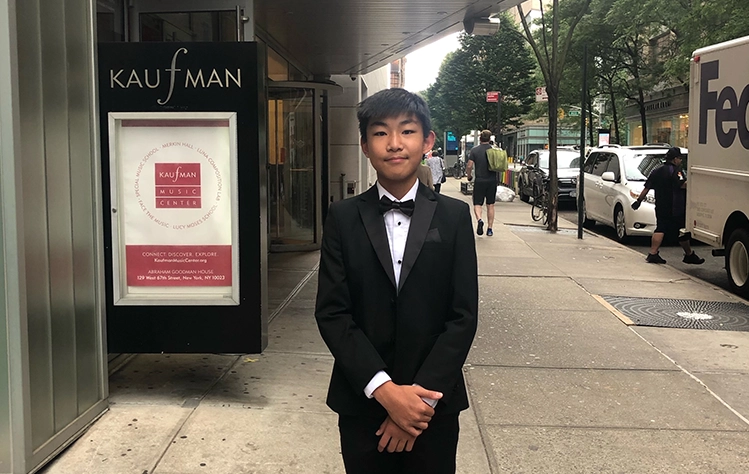
If CMS is the community, Zena Ilyashov is the heart of Jerry's musical story. She recently celebrated her 80th birthday, and her students across the years turned out in force to mark the occasion. Jerry is among the most devoted.
"I owe everything, music-wise, to Zena," he says. "She's been more than a teacher for me. She's been like a mentor, almost like a family member. She really genuinely wants me to succeed. My success is her success."
But when he talks about what she specifically gave him, he goes somewhere more interesting than technique. What set Zena apart, Jerry says, is that from the very beginning, she emphasized expression — the idea that notes on a page are only a vessel for something bigger.
"Because she was able to focus on the value of expression at such a young age, my entire perception of music shifted," he explains. "I see music less as a practice and more as an art form, as a creative form, as a way to convey my feelings, as a way to paint a picture."
This showed up in the details of every lesson: a focus on phrasing rather than just accuracy, and concern for whether a musical line flowed or sounded "choppy" — her word. Many other teachers, he notes, spend the early years drilling technique. That's important too. But Zena's priority was different, and it left a lasting mark.
When Jerry was young, he moved way too much at the piano. His parents would tell him so. Zena, though, wasn't worried. She knew he'd refine it as he matured. More importantly, she knew what it meant. "She knew that means I'm focusing on the expression and not just the notes," he says.
"Don't hide your expression," he says, summing up what she taught him. "In life, that leads to deeper connections with people. If you're genuine, that's how you can truly connect. You don't really connect with people if you're not genuine about it."
The Moment on the Bench
Among all the awards, performances and recognitions — and there are many — one experience stands out for Jerry above the rest.
In January 2025, he competed in the David D. Dubois International Piano Competition. It had been almost a year since he had done any serious competing or major performing. He'd felt himself drifting from music a little — worried, quietly, that he might not get his touch back.
He prepared a 30-minute program with everything he had. The competition was in Bowling Green, Ohio, in the middle of a cold winter. Before the final round, he found a bench outside on the college campus, overlooking a frozen lake. He sat there in the snow and thought about the Rachmaninoff Prelude he was about to play.
"In that moment, I felt much more at peace," he says. "Like music will always be a part of me. And like, even if I don't win this competition — I kind of have this music back in me. I've practiced to this level. These 30 minutes of music are my version of this."
He did win. But the win wasn't the point. The point was what happened on that bench — the quiet recognition that the thing he loved hadn't left him, and he hadn't left it. "It made me feel very powerful. Very fulfilled."
It's a lesson he knows he'll need again. "I'm sure what I experienced was just a fraction of what somebody who has made a career in art has gone through," he says. "But it makes me a little bit more optimistic about the future."
Music, Mind and What Comes Next
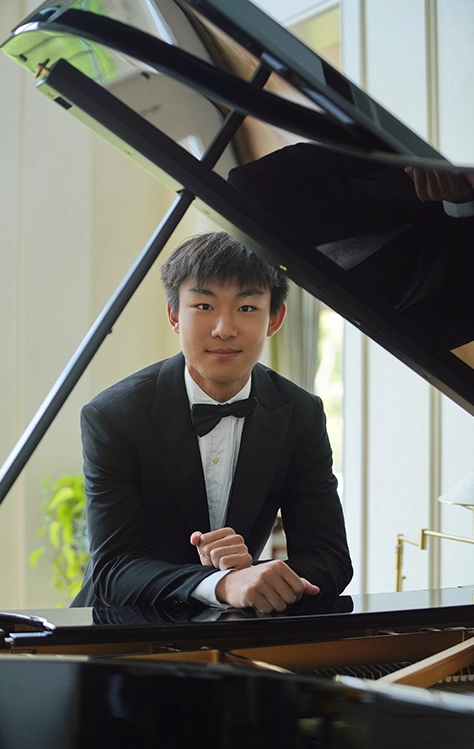
At Harvard, Jerry will study cognitive science and government — not music performance. That might seem like a pivot, but he traces the whole thing back to something that happened in concert halls.
Playing for different audiences over the years, he kept noticing a pattern: certain pieces seemed to reach people across all kinds of divides — age, background, musical experience. A serene piece would quiet a room. You could feel it. "How can such different people have such similar reactions to this music?" he started asking himself. That question became a research project in high school, then a real passion, and eventually a direction.
The Harvard program he applied to — Mind, Brain, Behavior — brings together neuroscience, linguistics, behaviorism and artificial intelligence under one umbrella. It sounded, to Jerry, like exactly the right place to keep pulling on the thread that music handed him.
He'll keep playing, too, just not as a formal major. He's particularly excited about chamber music — something he hasn't had enough time for during the competition-heavy years in St. Louis. He'd especially like to tackle Brahms's Piano Trio No. 1 and the Rachmaninoff Cello Sonata, whose third movement he calls his favorite of all time. He knows musicians at Harvard and at the New England Conservatory nearby, and he's already thinking about who he might play with.
"Music will always be a part of my life," he says. "No matter where I am or who I become or how old I get."
Grateful, and Going
As Jerry gets ready to close this chapter, the word that keeps coming up is gratitude — for his parents, for Zena, for CMS and the people who showed up for him, sometimes with scholarships, sometimes simply with encouragement and opportunity.
"Somebody like that can't do anything just on their own," he says, thinking about the kid he was at 8, or 12, or 15. He means it without a hint of false modesty. The community made it possible.
He's also thinking forward. He admires people who become successful and give back to the communities that shaped them — with time, with resources, with attention. "I think having this foundation for so many kids," he says of CMS, "I'm sure many people will reflect their gratitude through whatever means they can."
He'll be one of them. Just, for now, from Harvard. We wish Jerry all the best as he heads to Harvard this fall.
About Community Music School: CMS has served the St. Louis community for decades, providing music education to students of all ages and backgrounds. To learn more or to support our programs, visit webster.edu/cms.